

Book Review: The Spy Who Came in From 1776
Former CIA analyst Gina Bennett has turned to spy fiction.

My Turkish mama goes all out for any meal—from the appetizers (because you can’t simply have one..) to the main dish/es (because, sometimes, you can’t have just one of those either) to dessert. Food is her love language. For a long time I thought that is why she’d say that Thanksgiving is her favorite holiday—over the Muslim ones she, as a deeply spiritual person, holds dear. One year, as we were prepping for our family meal, she noted how wonderful the idea of celebrating gratitude is; a day devoted not to a prophet, an event, or the position of the moon, but simply to give thanks. That is wonderful indeed. Happy Thanksgiving.
I’m thankful to Karen Greenberg for this book review of Gina Bennett’s spy thriller, If Two of Them Are Dead. I’m doing a giveaway below.
Planning to be back with a regular newsletter on Friday, December 5, from Doha! Let me know if you’ll be at the Doha Forum!
For the algorithm! If you believe in raising women’s voices and diversifying the pundit landscape, please love this post by hitting 🖤 above —and, please, share with others. If you ❤️ the newsletter, please become a paid subscriber. —Elmira
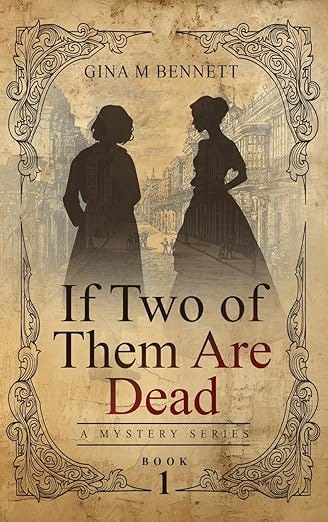
The name Gina Bennett is well-known in the counterterrorism world. The former CIA intelligence analyst is duly credited with being the first person to identify Osama bin Laden as a threat. The year was 1993. Bennet was 27 years old and working at the State Department, soon to transfer to the CIA. Eight years later, the devastating attack on the Twin Towers would cost nearly 3,000 lives and launch the US war on terror.
Fast forward three decades. Bennett has retired from the government and has taken up a new pursuit—writing spy fiction. Or more accurately, female spy fiction. As history tells it, Benjamin Franklin once opined, “Three can keep a secret if two of them are dead.” His answer not only underlies the book’s title, If Two of Them Are Dead, but also invites in a dominant theme of the book—namely, the special attributes that women bring to intelligence. “Clearly Mr. Franklin has never known a woman spy,” we are told.
In her wonderfully engaging novel—the first in an anticipated series of three—Bennett portrays two American female spies working together through the magic of time travel across the span of two and a half centuries. One lives in revolutionary times. The other in 2024. The colonial era Sarah, a young woman carrying a near-full term pregnancy, is working secretly on behalf of George Washington and the revolutionary cause. Historians have long studied the presence of spies during the war for independence, one of which was the Culper Spy Ring to which Sarah—Agent 355—belongs. Agent 355, the only member of the Culper Spy Ring who was never identified, is widely considered by historians to have been a woman. As Bennett relates, Agent 355 “was believed to have been a lady of high society living in Tory-dominated Manhattan” who turned out to “be the spy to inform General George Washington of Benedict Arnold’s plan to betray the patriots.” Sarah embeds herself within the high society world of British-aligned colonists, passing messages to Washington and his allies, in an attempt to disrupt what would have been history-altering plans had they come to fruition. British Major Andre and the soon to be traitor Benedict Arnold are the focus of her efforts.
Ruth, living in 2024, works for the CIA and is given the assignment to grapple with a question that seemingly belongs to a decades-old spy investigation. In the late 20th and early 21st century, three Russian moles were uncovered within the CIA—Aldrich Ames, Robert Hanssen, and Edward Lee Howard. Ruth has been asked to look into whether there was a fourth Soviet mole—spying from within US national security agencies. Except, Ruth finds her investigation—and her life —abruptly interrupted by a vastly more compelling task. A doorway hidden in an antique, revolutionary era “lady’s writing desk” sends her reeling back through time, away from her adoring husband and two young sons and into the revolutionary era where she encounters Sarah.
Immediately, the two women bond with one another, discovering that they have much in common. Ruth sees in Sarah a “fellow spy,” one with talents that stand up even to 21st century standards. Impressed by Sarah’s innate understanding of the subtleties required to embed herself in places where she can discover the plans of those opposed to Washington and his cause, Ruth honors her revolutionary colleague with the title of “founding mother of American intelligence.”
Together, the two women embark upon a plan to discover and then disrupt a plan that would have changed the course of history, one in which the British States of America would have become the reality.
Bennett uses the alliance between the two women as a chance to reflect on spycraft and more directly, on the talents unique to women spies. Then as now, good spycraft relied on the ability to “keep the lie as close to our truth as possible.” Then as now, disinformation is both a weapon and a tool, as is surveillance and counter surveillance. In fact, Ruth has her doubts about the benefit of technology when it comes to spying, musing that “(p)erhaps spying in the 1700’s was so elementary—with no technology and very few gadgets to make it exciting—that it accelerated one’s perception.”
The greatest similarities in tradecraft are skills which, Bennett tells us, are largely innate to women. Ruth marvels at Sarah’s intuitive capacity, her understanding that “a person’s truth or falsehood is revealed by the language of their body.” To herself, Ruth recalls a recent book on “The Female Brain” and its thesis that “having to understand the needs of non-verbal infants” the female brain had evolved into a heightened capacity to “read subtle facial expressions and body language.” Wondering why, given this reality, there are not more women spies, Ruth finds herself wishing she could bring Sarah back through time to the current day.
But it is not only intuition and instinct that unite the realities of Bennett’s female characters. According to Bennett, the circumstances of women have changed all too little and, thus, have created realities that defy the passage of time. As women, they are, in the past as well as the present, perpetually underrated, and, as such, are able to catch men—and women—off guard “with skills they assumed you didn’t have,” including flattery and flirtation to deceive others as to their true purpose.
Aside from spycraft, there are other cross-century consistencies as well. Both Sarah and Ruth live in a world where women are not safe. “It is the fate of women of all classes that they are never safe alone.” As Ruth sees it, their safety is even less assured in the future than the long ago past. Ruth and Sarah understand that not only do women left alone face likely peril but that women who act alone encourage suspicion. As a result, they back up one another’s stories, provide distractions for one another’s guile, and keep a perpetual lookout for the dangers that may confront the other.
Though the novel is largely focused on the relationship between Sarah and Ruth, men are not without their merits in Bennett’s tale. Ruth’s husband Ryan, whom she nicknames Mr. Darcy, after Jane Austin’s lead character in Pride and Prejudice, is as loving and supportive as imaginable, unflaggingly respectful of the wrenching pressures that steal his wife’s time, attention and presence from him and their two sons. So, too, her “fastidiously ethical” supervisor at the CIA steadfastly champions her skills, trusting her on one occasion with knowledge she is not authorized to have.
Throughout, Bennett suggests with artful subtlety the overlap between the skills of intelligence work and the art of fiction writing. For both, the smallest detail is important. Gestures, possessions, and silently made choices, resemble the unspoken intentions of enemies. The tiniest detail can unmask the intentions of a bad actor planning subterfuge just as it can reveal the deeper nature of a character’s wishes.
Ultimately, Bennett’s impressive novel, while using women and spycraft as her frame, is a tale about the treasure of American democracy. Hers is a call to appreciate rather than take for granted its very existence. In 2025, one cannot help reading it without a tinge of recognition that Bennett’s ultimate aim is to help readers value the ideals of the country’s founding while suggesting that its existence is precarious now as it was then. One leaves the novel with the feeling that instead of Ruth transporting herself to the past, perhaps Sarah should come into the present as Ruth had wished in order to help the country preserve its democracy at this perilous moment in time. —Karen
📚 Interrupt Your Bookshelf! 📚
Enter the drawing to win a copy of Gina Bennett’s book, If Two of Them Are Dead. Submissions close on Monday, December 1, 9:00am ET. And if you don’t win a copy, get it on Tertulia! A woman-run alternative to Amazon. Let’s support women.
Editorial Team
Elmira Bayrasli - Editor-in-Chief
 | A guest post by
|
Grateful for Elmira! And for this book recommendation, it looks great!
Grateful for this ever fascinating newsletter and the brilliant woman behind it!