

Cuba: Maximum Pressure, Minimal Plan
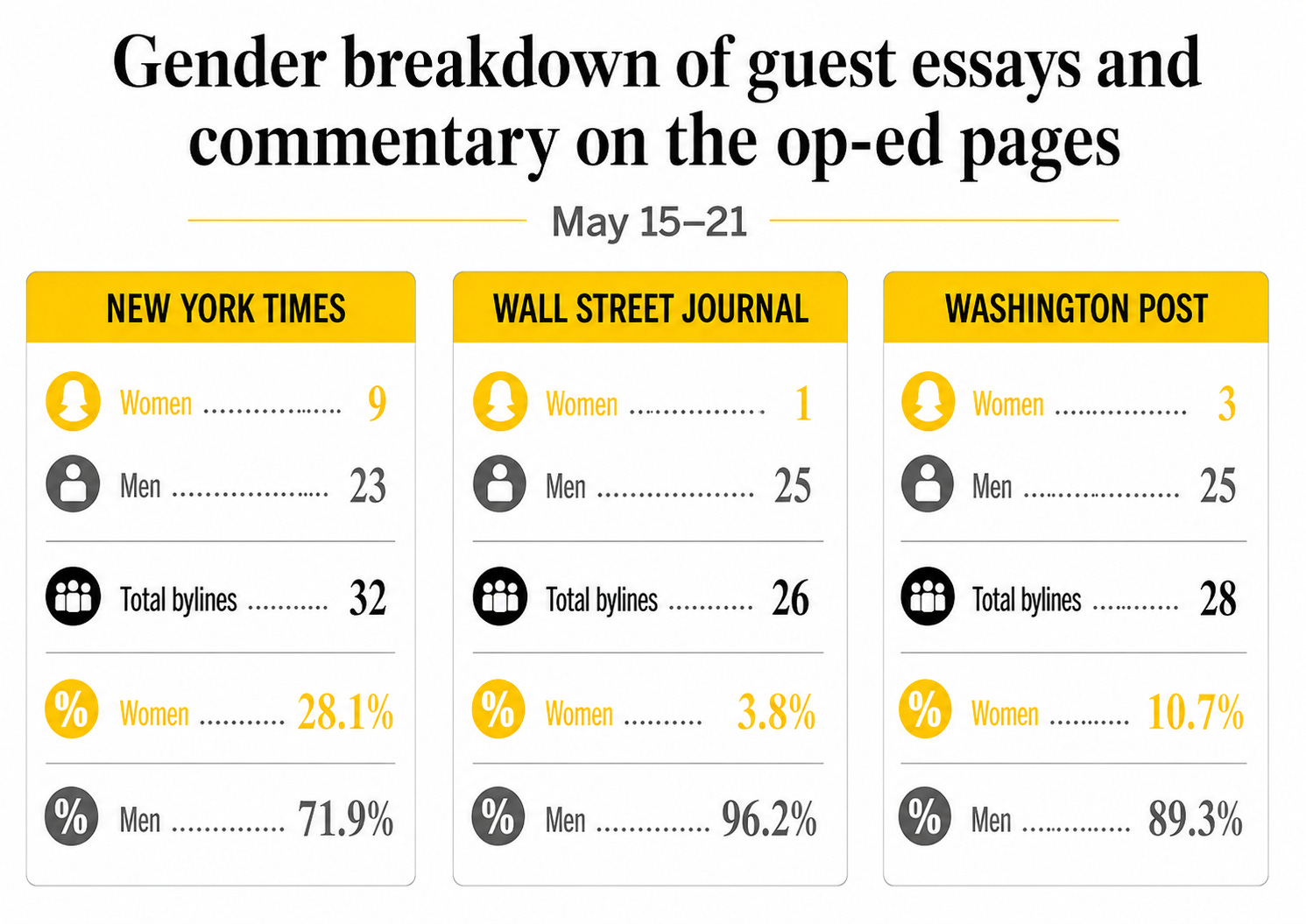
Reeling from Iran, Trump is making moves on Cuba. But that's all it seems to be. Meanwhile, Iran is working on deals to charge ships in Hormuz. And the Gender Tracker shows... 🙄

Happy birthday Lynda and Neece!
Honoring the men and women who serve this Memorial Day. Next Wednesday marks Eid al-Adha, the feast of sacrifice. It marks the end of the holy Hajj pilgrimage and honors Abraham’s faith and willingness to sacrifice his son. Eid Mubarak and İyi bayramlar.
Go Knicks. 🙌
No Postscript today, as I wrote a longer piece on Cuba in This Week in the World…
Would love to know what you think, or what I got wrong or left out— here’s my email.
This Week in the World.....

On my radar...
Cuba
Raúl Castro, brother of Fidel, is 94 years old and no longer runs Cuba. But this week, Donald Trump’s Justice Department indicted him anyway.
The charges, tied to the 1996 shoot down of planes flown by Brothers to the Rescue, a Miami-based Cuban exile group, thrilled the hardline, largely Republican-leaning Cuban American community in Florida. The question is whether they will stay enthusiastic.
That’s because Trump, who is facing low poll ratings as a result of his war on Iran, is pursuing a win in Cuba, which has never been weaker. The island is suffering through a massive fuel shortage and widespread blackouts. Yes, no oil, so Cuba can’t upset the global supply chain. Hence, launching an overnight operation to capture Castro, like the US did with Nicolás Maduro in Venezuela in early January, might be appealing. The problem is, Cuba is not Venezuela.
Soon after the indictment, Trump said he did not think further escalation was necessary, but has since flip-flopped saying that he might be the president to finally intervene in the country. So, there seem to be three scenarios:
US intervenes in Cuba
the regime collapses
US pressure will force Havana to the table to negotiate the release of prisoners, reduce Chinese and Russian influence, and open the country to American business. China and Russia value Cuba because of its proximity to the United States and use it as a base to spy. Both have condemned Castro’s indictment.
That is where Trump and the Cuban American hardliners who have shaped US policy toward Cuba for decades could clash. For those hardliners, engaging with the regime would be a betrayal. They want regime change—full stop. But what comes after that regime changes? I’m not seeing any plans for a Delcy Rodríguez-like figure to take over in Havana. There are no opposition figures in Cuba. Does the US go and occupy the country?
Secretary of State Marco Rubio, the son of Cuban immigrants, addressed Cubans directly in Spanish, this week, telling them: “The real reason you don’t have electricity, fuel, or food is because those who control your country have plundered billions of dollars, but nothing has been used to help the people.”
There is truth to Rubio’s words. Havana’s rulers have presided over corruption, repression, economic failure, and staggering misery. (Sounds like a country I know…) But it is also contradictory. The administration says it wants to help Cubans and talks about restarting economic ties and investment, but it has also imposed a secondary-sanctions framework that makes Cuba even more toxic for foreign companies and banks.
On May 1, Trump issued Executive Order 14404, which extends sanctions risk to non-US companies and foreign financial institutions that deal with sanctioned Cuban actors or sectors. That makes Trump’s talk of economic opening harder to take seriously.
With the threat of either a military intervention or a collapse of the state, it’s doubtful that we’re looking at a free and stable Cuba anytime soon—or an easy win for Trump.
Does indicting Castro show how far Trump will go in Cuba? Carla Gloria Colomé thinks so. (El Pais)
Cuba needs a long term solution to its energy crisis, write Luisa Blanco and Isabella Elias. (The Conversation)

Iran
Trump said that he had planned to resume US strikes on Iran this week, but refrained after several Gulf leaders appealed to him. Meanwhile, according to Axios, he seems to have exchanged heated words with Israeli Prime Minister Benjamin Netanyahu. The two had a call this week in which Netanyahu, not surprisingly, argued to resume the war, while Trump was holding out to see where a new proposal that Qatar and Pakistan worked out will get him.
As Iran considers that proposal, Ria Reddy, Carolyn Moorman, Nidal Morrison, Katherine Wells, along with others, note that Iran is working to cement its control over the Strait of Hormuz by working out bilateral agreements with various Gulf nations—and charging upwards $150,000 in tolls to vessels that need to be “escorted.” (Institute of War)
Caroline Alexandar backs that up with a piece on Iran-Oman talks over the Strait. (Bloomberg)
This is no doubt not something Trump will like.
The closure of the Strait of Hormuz is forcing Gulf countries to turn to overland pipelines to export oil. The UAE announced that its new pipeline is 50 percent complete, and will be ready by 2027. All of it will reconfigure the region’s supply chain—and Iran’s leverage, writes Hadley Gamble. (The National)
Meanwhile, Parisa Hafezi and Rami Ayyub scooped that Iran’s Supreme Leader, Mojtaba Khamenei, has “issued a directive that the country’s near-weapons-grade uranium should not be sent abroad.” (Reuters)
Putin in China
Xi Jinping has been a busy host. No sooner had the US president left Beijing did Russian President Vladimir Putin pay a visit. And that was no coincidence. Xi is eager to show that China is now the global center of power and that Trump’s visit doesn’t change China’s relationship with Russia. That’s something that suits Putin just fine. As his war on Ukraine continues, badly, the Russian president wants to show that he’s not isolated—and wants to make sure that China continues to buy its oil. That’s why he must have been disappointed that there as no agreement on the Power of Siberia 2, a gas pipeline project that would carry Russian gas from Siberia to China.
Yu Jie points out that the failure to reach a deal on Power of Siberia 2 demonstrates China’s fear of becoming dependent on Russian energy. While geography and a mutual distrust of the West unite Xi and Putin, she outlines how there is a limit to their bromance. (Chatham House)
Oh, and if you’re wondering whether Xi is done with trying to move the US on Taiwan… He’s holding up Elbridge Colby, the under secretary of defense for policy, until the US scraps the $14 billion weapons sale to Taipei, reports the FT.
US
Suzy Hansen zeros in on how Pete Hegseth is not merely a Trump cabinet appointment, but the consequences of a military-centered, America-the-mighty foreign policy that fails to understand the rest of the world, much less respect it. It’s easy to fault Hegseth and Trump, but the Democratic establishment is responsible for the moment we’re in too. (NYRB) 🎁🔗
Africa
The World Health Organization declared an Ebola a public health emergency this week, following outbreakds in the Democratic Republic of Congo (DRC) and Uganda. As of May 20, 139 have died and there are nearly 600 suspected cases. Keren Landman on how Ebola spreads and why it’s so hard to contain. (National Geographic)
And if you’re thinking… hmmm… did those aid cuts have something to do with this outbreak, Kate Knibbs talked to health providers who confirm that there is a short supply of protective equipment, such as gloves, masks, and hand sanitizers. (Wired)
But, yes, Team Trump can find billions for January 6 rioters and trillions for more weapons for the Pentagon.
Femicides are rising in Kenya. Ivy Gichungo and Patricia Andago have an investigative report. (Africa Uncensored)
Asia
Trump and Xi’s summit may have put fears of a great power confrontation to rest. But the failure to touch on, let alone address the future of our global slowly collapsing governance architecture should still alarm us, warns Tatiana Carayannis. (PassBlue)
North Korea beat South Korea this week—in soccer, women’s soccer to be exact. The Naegohyang Women’s Football Club beat Suwon FC Women in the semifinals of the Asian Football Confederation Women’s Champions League in South Korea. It was the first time since 2018 that the two countries have had civilian-to-civilian contact. That’s worth noting, write Cathi Choi and Solby Lim. Both point to the importance of this type of engagement to reduce tensions but also work towards resolving their on-going conflict, which as they remind us has never formally ended since 1953. (Common Dreams)
The Americas
Bolivia has been rocked with protests against the center-right president, Rodrigo Paz. He was elected in November, ending the hold that the leftists had on power. Paz’s appeal was to improve the economy, reduce inflation and end fuel stortages. As Alexandra Sharp points out, the situation in the country has only worsened. Union leaders and allies of former president Evo Morales have called for Paz to resign. That has prompted the Trump administration to call what’s happening a coup. (Foreign Policy) 🎁🔗
Middle East
Following the arrest of several pro-Palestinian protesters, Itamar Ben-Gvir, Israel’s national security minister, is taunting them. Rather than being an isolated incident, says Yara Hawari, it speaks to the actions of the country. (Al Jazeera)
In Turkey, a court removed Özgür Özel, the leader of the main opposition People Republican Party (CHP). This clears the way for former party leader Kemal Kılıçdaroğlu to return to the helm—the man who was voted OUT from the position. Ezgi Akin notes that this marks a “major escalation in the legal crackdown on the CHP.” Last year, CHP member and İstanbul mayor Ekrem İmamoğlu was arrested. He remains imprisoned. (Al Monitor)
This is Erdoğan’s effort to control and weaken the opposition, as the country looks at elections in 2028. Installing Kılıçdaroğlu does exactly that. Ahu Özyurt asks if this is an effort to kill off the party that Turkey’s founder, Mustafa Kemal Atatürk founded. (It’s in Turkish).
Turkish President Recep Tayyip Erdoğan has pushed Turkey further towards authoritarianism. Clamping down on the opposition is one example. But as Selime Büyükgöze points out, it is feminists who remain a “consistent, visible, and expanding political force” in the country. (International Politics and Society)
Europe
In the UK, Keir Starmer is still the prime minister. But it increasingly looks like Andy Burnham, the mayor of something called Greater Manchester, is the favorite to unseat him. That would require him to get into parliament first, which if you ask me is risking too much—especially in an anti-incumbent atmosphere. Who is Burnham? Kate Laycock dives in. (DW)
Last week, Latvia’s government collapsed following finger pointing among coalition partners over Ukrainian drones that entered the country’s air space. So, this week, Russia did it again! Jamming drone signals it diverted Ukrainian drones into Estonia and Lithuiania. Way to test Baltic cohesion. Justina Budginaite-Froehly argues that the Baltic states and NATO need to coordinate not only on messaging but these “sub-threshold” provocations meant to intimidate the alliance without triggering open conflict. (Atlantic Council)
Under the Radar
This week, the UN General Assembly adopted a resolution that each member state has a responsibility to protect citizens from climate change. Eight countries voted against it, including the US, Russia, Iran, and Israel. (UN News)
The Gender Tracker
After a month of tracking guest essays and commentary in the New York Times, Wall Street Journal, and Washington Post, one thing is obvious: men dominate the op-ed pages. Across four weeks, women made up just 20.5 percent of bylines—roughly one in five. The New York Times does the best, with women accounting for 29.1 percent of contributors, though many of the women who appear there are regulars. The Wall Street Journal and Washington Post were far worse, with women making up just 15.2 percent and 14.2 percent, respectively. There were fluctuations week-to-week, but nothing that suggests a real shift. Bottom line: this isn’t one bad week. It’s a pattern. Yes, I’m going to widen this to include other publications and podcasts.
Friends of Interruptrr
Career coaching has made a real difference for me, and I’m happy to recommend someone I’ve worked with and trust: Bene Cipolla of Allium Partners. Bene helps leaders find their path forward through growth, change, and uncertainty, offering coaching and consulting on leadership development, strategy, organizational design, and change navigation. Interruptrr readers get 10% off. Definitely worth considering.

Opportunities
She Should Run’s Local Leader Lab is taking applications for women who want to or are working on a civic project. Apply by June 7.
In DC, CFR is hiring for an Associate Director of Research to the President.
NYC or DC, Razom is hiring a Manager, People Operations.
In NYC, Women Moving Millions is hiring for a Community Events Manager.