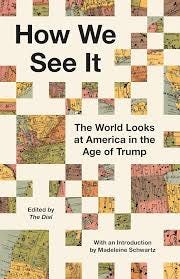


I’ll be landing in Madrid 🇪🇸 when this lands in your inbox. Between the long holiday weekend, traveling, and surviving celebrating Eid with my family, which is called bayram in Turkish, I’ve handed my pen over to Kate Brannen. Kate’s written here before and I’m thrilled that she’s reviewed an upcoming book, How We See It: The World Looks at America in the Age of Trump. It’s a compilation of essays from The Dial, which is a “friend of Interruptrr.” I LOVED this book. Though the subtitle says “in the age of Trump”—it’s not about him, per say, but the many facets of how America interacts with the world. Each essay has a different voice and perspective. And I learned a lot. It hits bookstands on June 9. If you’re in NYC, The Dial’s Editor-in-Chief, Madeleine Schwartz, will be at McNally Jackson for a conversation with Suzy Hansen on June 10.
Luckily, I sat down with Madeleine and one of the contributors, Lucía Cholakian Herrera, an Argentine-based journalist before jetting off. Our conversation is above. Substack doesn’t allow you to move around the format of the video. It’s one of many complaints I have about Substack’s video feature…The weekly roundup of links and the Gender Tracker will land in your boxes separately later—this morning or Saturday! It’s been a busy week…
And speaking of book reviews, check out this one by Natalia Kopytnik of Nino Haratschwili’s book, The Lack of Light: A Novel of Georgia. (Lossi 36) Georgia the country, not the state. 🇬🇪
I plan to run more book reviews moving forward, which will only be available to paid subscribers. Yes, dear reader, I’m going to put some parts of the newsletter behind a paywall. A gal’s gotta pay her bills…More on that when I’m back from Europe. Back to book reviews…I’m reaching out to various individuals to review largely non-fiction books—by women and men. In addition to there being a dearth of women on the op-ed page, there is a dearth of women reviewing non-fiction books; and most non-fiction books in geopolitics are by men. If you’re interested in being one of those people, get in touch.
Note: Be on the lookout for a special edition on Tuesday on Feminist Foreign Policy and Spain’s convening in Madrid. I talked to Lyric Thompson, Founder and CEO of the Feminist Foreign Policy Collaborative about Spain’s foreign policy and whether Spain can save feminist foreign policy. —Elmira

Book Review
By Kate Brannen
Across the globe, foreign governments are having regrets about how much they have come to depend on the United States. For decades, it was a relatively safe bet. The United States was a reliable partner, even as administrations—and political parties—in Washington changed. It was committed to free trade, the rule of law, and multilateral institutions, which it helmed. With dependable US leadership, other countries were incentivized to join the rules-based order. The US dollar was a strong, stable currency. Countries courted US companies because they offered investment and jobs for their citizens.
Now, a year into Trump’s second term, it’s becoming clear (if it wasn’t already) that the United States can no longer be trusted. It is acting like the kind of rogue nation it used to warn against. The country seems to have lost its mind because Trump is a chaotic, unpredictable, and crass ruler, but also Americans voted for this mad king … twice. From Ireland to Argentina, countries are waking up to the fact that the country they had come to depend on more than any other has deeply changed, and they have to figure out what to do about it.
This epiphany and the questions that stem from it dominate a new book of essays titled How We See It: The World Looks at America in the Age of Trump. The book, which was put together by The Dial, an online magazine with an-all female editorial team, features 12 writers, who are located everywhere from Gaza to Ukraine.
Dónal Gill, an Irishman who teaches Canadian politics in Montreal, laments the dependent relationship Canada developed with the United States, an arrangement that began in 1988 when Canada embraced a sweeping free trade agreement with its southern neighbor. Because of that interdependence, it has too few political options to deal with Trump, who threatens Canadian sovereignty and drives up tariffs whenever he’s upset. Culturally, the United States also came to dominate its neighbor. “The students I meet are often better acquainted with the fifty states of the United States than with Canada’s ten provinces and three territories,” Gill writes. Today, young Canadians are not entirely sure of their national identity, but Trump’s bullying is pushing them to define and embrace it.
Michelle Kuo reflects on how Taiwan placed so much faith in American leadership, but with even higher stakes than Canada. In Taiwan, people are watching Trump closely to see what his commitment to Taiwanese independence ultimately is. Kuo notices, like many of the book’s authors, that her country has put its fate in the United States’ hands, but that Trump handles that grave responsibility with total carelessness. Although he sees himself as playing god – the ultimate arbiter of who lives and dies, which companies succeed or fail, which civilization survives the night – he wields this power with the seriousness of a child playing with toys. With diminishing faith that the United States will have its back if China invades, the Taiwanese people are leaning into their civic strength and unity, the very virtues lacking in American society today.
For Muhammad al- Zaqzouq, a writer from Gaza, the United States has loomed large in his imagination since he was a young boy. Growing up, his notion of America was vague, but he knew to associate it with a vast, epic power. “A simple awareness grew within me that we were a weak and vulnerable nation held down by America the superpower,” he writes. As he gets older, his understanding of the United States grows more sophisticated but it still seems to him that this place – America — “was always at the center of everything.” After Hamas’ attack on Israel on Oct. 7, 2023, Israel launched its war on Gaza, destroying al-Zaqzouq’s world. He watches as other Palestinians, with connections to the United States, get to escape the horror show. “I wanted to receive that phone call from the embassy telling me that I would be on the next convoy out of Gaza with my three children,” he writes. It’s then that he realizes, “that the Palestinian catastrophe goes beyond the occupation and is connected to a global hierarchy that values certain lives more than others. American Palestinians are treated as human beings, while regular Palestinians are left to die in silence.” The experience leaves him asking: “How can America be the power we fear as well as the power that can deliver us?”
Jessica Traynor, an Irish poet, surveys her country after 25 years of investment from US tech giants. “While their contribution to our GDP has been huge and successive governments have scrambled to make Ireland attractive to them, their effect on individual citizens can be intangible at best, and at worst, detrimental,” she writes. The reality is that companies such as Google and Meta have become so valuable to the economies of countries like Ireland that their executives are in a position to dictate terms that may not be beneficial to the voters. Traynor wonders how any of this can be unwound.
In Argentina, Lucía Cholakian Herrera writes about how dependent her country became on the US dollar, which offered Argentinians a lifeline during successive financial crises, but its outsized role also undermined the local economy by taking so much Argentinian money out of the formal system. Now, like so many other places, Argentina has to grapple with what happens when the thing you thought was stable–a sure bet—starts to wobble?
Countries are asking this question about their relationship with the United States, but it is also playing out on the individual level, especially for foreign students and immigrants who assumed living in the United States would offer salvation and opportunity. Abraham Jiménez Enoa, who fled Cuba as an adult, confronts a Cuban population in Miami that is obsessed with Trump. They have put all of their hopes and dreams on him, he observes. “In Miami, Trumpism is just as overwhelming, and as fundamentalist, as Castroism is in Cuba. Anyone who disagrees is intimidated, often too afraid—of confrontation, of rejection, of stigma, of being a minority in the face of an ideology that not only hates difference and diversity but tries to violently destroy its opposition—to speak up at all.” Ahmed Naji, who was jailed in Egypt for his writing, experiences freedom when he arrives in the United States in 2018, but by the time The Dial asks him to write for this book, he wonders: “Can I still write freely about my America in a time of war?” The adopted country he had come to love is becoming unrecognizable.
Interestingly, the essay on Ukraine, a country that is heartbreakingly dependent on the United States for economic and military support in its war against Russia, does not focus on this glaring vulnerability. Instead, the journalist Nataliya Gumenyuk, like Michelle Kuo in Taiwan, sees her country’s strengths as the same virtues missing in American society. “The war revealed to us what a state truly is,” she writes. In wartime, the state provides “the services that hold a country together,” including “trains running to frontline areas, a health care system capable of treating thousands of wounded, schools and universities continuing to teach— sometimes online, sometimes under occupation—and civil servants adapting services for millions of displaced people.” In the United States, however, the government is “often suspect, seen by some as a threat to freedom or an inefficient relic.” Americans are bogged down in the wrong debates, fueled by disinformation, suffering from “a profound inability to discuss seriously how the state can serve the public good.”
Reading these essays, I registered the profound shock these authors felt, similar to realizing you’ve married a madman, or that you’ve become dependent on a madman to protect you from the madder men. Reflecting on the United States tends to prompt these writers to think more deeply about their home countries—and feel new appreciation for them–more than offer any new insight into the United States under Trump. For an American reader, this is just as helpful because we spend far too little time getting to know our neighbors, our allies, or our enemies. It is also imperative for Americans to understand how poorly the rest of the world views the country, not just Trump, and to think about what that means for the country’s future–long after Trump is gone.—Kate
Kate Brannen is a freelance editor and Non-Resident Journalism Fellow at the Reiss Center on Law and Security at NYU School of Law.
📚 Interrupt Your Bookshelf 📚
Yay, the giveaway! You can win a copy of How We See It by entering a drawing. You must be an active Interruptrr subscriber and be in the continental US (sorry to everyone else!). Deadline for entries: Monday, June 1 at 9:00am ET.