
Hungary's Strongman Test
After 16 years, Hungarians are voting not only on the place Viktor Orbán has carved out for their country in the world, but also on the domestic bargain he struck at home, particularly with women.

Hungary votes today. And though it is a landlocked country of about 10 million in Eastern Europe, plenty outside the country have a stake in its outcome. They include Donald Trump, Vladimir Putin, and the European Union. For the past 16 years, incumbent Prime Minister Viktor Orbán and his Fidesz party have championed the global far right, while acting as a spoiler in Europe, particularly regarding the continent’s support for Ukraine.
Certainly, Orbán’s role on the world stage will be a factor in the election. Hungarian political analyst Péter Dósa noted that “ultra-rich businessman and former Fidesz insider György Wáberer” has said “Sunday’s election is really about whether Hungary belongs to Europe or Russia.”
While Washington, Moscow, and Brussels are watching what Orbán means abroad, this election is also a test of what his politics have meant at home—especially for women.
For Orbán, women are central to the national project—as mothers. He has made Hungary a showcase for pro-natalist politics, promoting traditional family roles and coupling them with policies meant to encourage childbirth. In Orbán’s telling, these are not simply social policies—they are matters of national survival. That message has helped him build support, particularly among older and rural Hungarians who connect with his message of “protecting” the nation.
But over the past decade and a half, Hungary’s economy has stopped growing. In July 2025, The Economist noted that Hungary’s economy would only grow 0.8 percent over the next year. It has one of the highest rates of inflation and public debt in Europe and one of the lowest living standards. Will older and rural voters still buy Orbán’s claim that family, motherhood, and protection serve their interests?
But first, some background:
Orbán is regularly counted among the authoritarian leaders that have dismantled press freedoms, stacked the courts with pro-Orbán judges, targeted minorities, in particular refugees, lashed out at feminists, and eroded democratic checks and balances. When he first came to power, he proudly said his aim was to turn the country into an “illiberal state.”
He has certainly turned it into a corrupt one. Orbán has enriched a network of cronies and loyal business elites through state favors and EU-linked contracts. Transparency International notes that Hungary is the most corrupt country in the EU, for four years in a row.
That’s problematic when Hungarians, like many people worldwide, are struggling to get by. It helps explain why polling ahead of Sunday’s general election suggests Orbán could be defeated, opening the way for 45-year old opposition leader Péter Magyar to replace him.
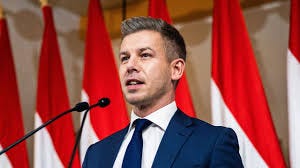
Magyar is a former member of Fidesz who joined Tisza in 2024. (After a nasty public divorce from Orbán’s justice minister, who had been the only woman in Orbán’s cabinet). Though a center-right party, Tisza is pro-European. Wikipedia tells me that Tisza is a portmanteau of the first syllables of tisztelet (respect) and szabadsag (freedom). Tisza is also Hungary’s second longest river. Its biggest platform is anti-corruption. That’s why it has become such a potent challenger to Fidesz. But can it win?
That’s not just a question of whether social media savvy and energetic Magyar can win over Orbán voters. It’s whether he can overcome the machine Orbán built—quite literally. In Politico, Jamie Dettmer and Max Griera point out that after the Hungarian ruler won in 2010, he gerrymandered an electoral system to favor him. In 2014, “Orbán offered citizenship and the right to vote to an estimated 2 million ethnic Hungarians living in neighboring countries.” Dettmer and Griera note that these voters tend to be older and conservative.
In 2021, Orbán passed “voter tourism,” “allowing Hungarians to register to vote anywhere in the country, even if they didn’t reside in the district.” This increases the risk of voters registering “in districts where a close race is expected.” This is bolstered by new rules in which “winner takes all” votes, a change from the proportional system that is widespread throughout parliamentary systems in Europe. The European Correspondent has an excellent explainer on Hungary’s voting system.
Straight out of the strongman playbook Orbán spent years consolidating control over much of the country’s media. He has packed state institutions with loyalists. If he loses, he will leave behind a system staffed by people with every reason to protect their positions and privileges. Any transfer of power, then, is likely to be messy, if not contested.
Back to the women—or rather “family”
For Viktor Orbán, women are primarily mothers. He is, as Population Matters notes, a global symbol of pro-natalism, advocating for higher birthrates—among Christian Hungarians, of course. Orbán has openly embraced the “great replacement theory” that claims elites are trying to “replace” white Christians with people of “mixed race.”
His government has adopted policies to encourage married women to have babies. It has extended tax exemptions for married heterosexual couples—not single women or those in the LGBTQ community— with three or more children, support for childcare costs, and subsidies on mortgages and car loans. Still, Hungary’s birthrates continue to decline. The Economist notes that the “country’s population has fallen from 10.7 million in 1980 to 9.5 million today.” It notes that in the absence of immigration, Hungary needs a “fertility rate of about 2.1 to maintain its population.” It currently stands at 1.31.
One of the obstacles to having children is cost. The Daily News Hungary noted in January that the cost of living, housing, utilities, and essential services, have outpaced wage growth. A key problem is the limited availability of affordable housing.
Another is choice and dignity. In 2021, Fidesz passed a healthcare law aimed to curb corruption. The inadvertent consequence has been that expectant mothers are not able to choose their obstetricians. In 2022, the party passed a law that requires any woman seeking an abortion to listen to the fetus’ heartbeat first and to get counseling. More To Her Story notes that the additional bureaucracy and humiliation drove Hungarian women to seek assistance outside of formal healthcare. The non-profit Women on Web (WoW) saw a 40 percent rise in requests for abortion pills from Hungary.
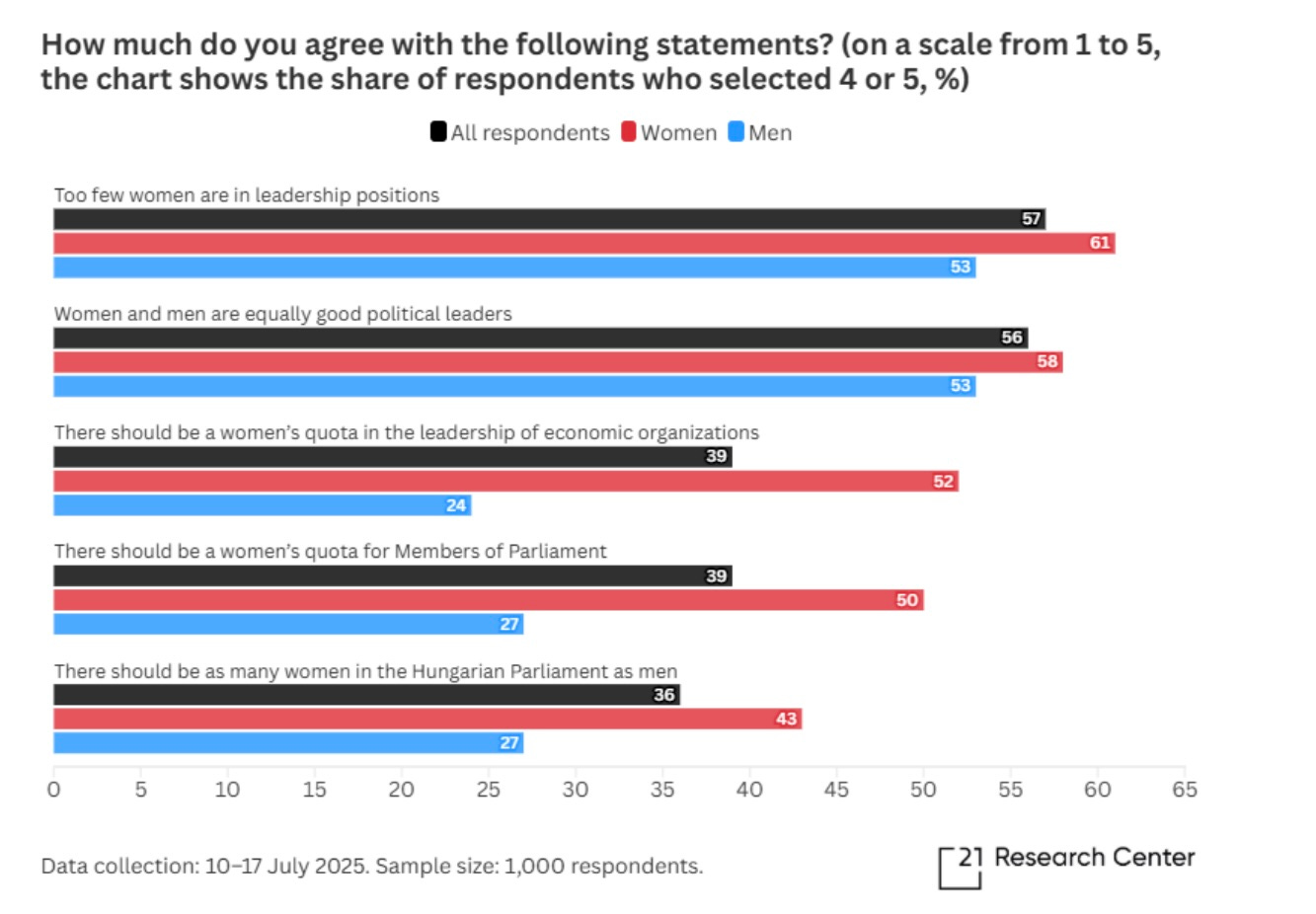
A July 2025 study by the Friedrich Naumann Foundation found the majority of Hungarian women feel that politics does impact their lives, but that they can’t influence it and don’t feel represented. They believe that while women are equally good leaders as men, too few are elected.
This is where it gets interesting for Tisza. Its national list is one-third female. There are about 60 women out of 185 candidates. Among Tisza’s top 10 candidates, five are women: Andrea Rost (who is an opera star, which deserves a separate post), Ágnes Forsthoffer, Anita Orbán (no relation to Viktor), Andrea Bujdosó, and Erzsébet Csézi.
In Fidesz, women only make up about 13 percent of candidates. The party currently has only 10 percent women in parliament. Orbán has an all-male cabinet. (He did have one woman, Magyar’s ex-wife who was the justice minister).
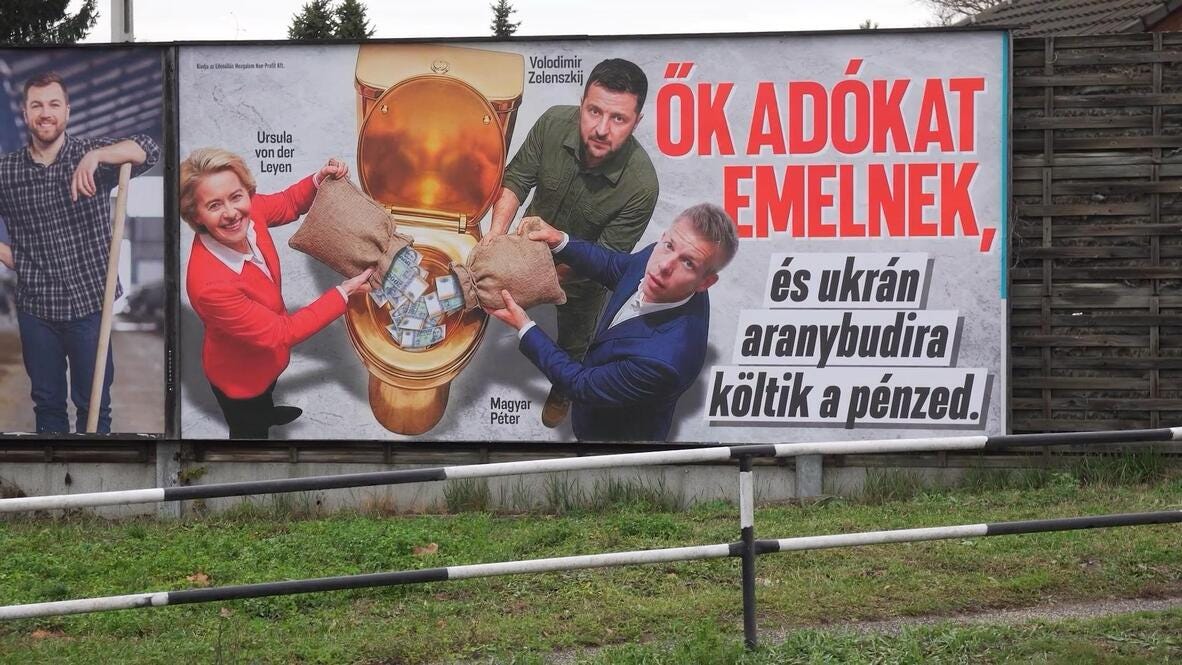
Yet, Orbán has a loyal following among older and rural women, who are drawn to his promise of stability and security. That helps explain a number of attack ads featuring Ukrainian President Volodymyr Zelensky. In one, Zelensky, European Commissioner Ursula Von Der Leyen, and Magyar dump money into a gold toilet. It reads: Ők adókat emelnek és aranybudira költik a pénzed. They raise taxes and spend your money on gold bars in Ukraine.
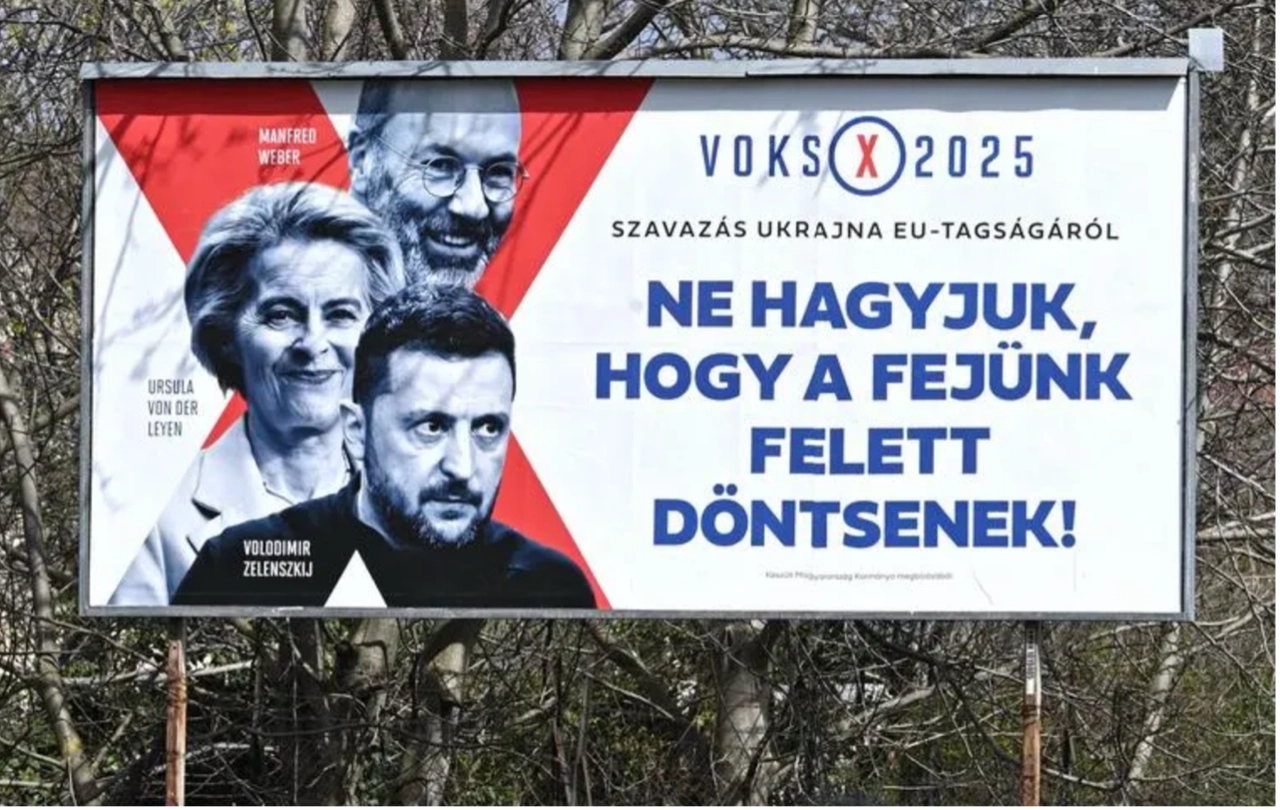
In another their three images appear with this: Ne hagyjuk hogy a fejünk felett döntsenek. Lets’ not let them decide over our heads.
Zsuzsanna Végh notes that for all his chest-thumping nationalism, Orbán’s campaign has looked outside of Hungary for victory. This past week, US Vice President JD Vance traveled to Hungary, ostensibly to demonstrate America’s support for Orbán. MAGA certainly doesn’t want to lose its biggest illiberal cheerleader. But, as she points out, Orbán’s “illiberal allies are not the ones who will vote in the Hungarian election on Sunday—Hungarian citizens are the ones who will.”
That’s something Péter Magyar has dialed into. He has run a campaign focused on the cost of living, corruption, and declining public services. He has proposed to let women choose their own doctor and extend single women government benefits for childbirth and care. Will it work?
As a Turkish-American, I have watched Recep Tayyip Erdoğan beat predictions and polls to solidify his power in Turkey over the past two decades. That is what strongmen do. I’m rooting for Hungarians today and for an outcome that represents their aspirations, not their fears. Fear and intimidation are what Orbán has peddled and built his success on. It deserves to fail. But as women know all too well, it is also how so many men survive.—Elmira