Indispensable, Together: The US 🇺🇸 & China 🇨🇳
Trump heads to China, with a shopping list and a bad hand.

As mentioned in Friday’s newsletter, my preview of Trump’s trip to China this week. ☺️ And if you haven’t filled out my survey, please do. It will help me understand my readers—and, hopefully, put out a better product!
Firm in the belief that the US was essential to global stability and prosperity after the Cold War, Madeleine Albright famously called it “the indispensable nation.” I remember when she and her speechwriter, Bill Woodward, wove that into her talking points when she was still the US Ambassador to the UN. The phrase caught on as Washington stood unrivaled on the world stage and set out to lead and protect the emerging order.
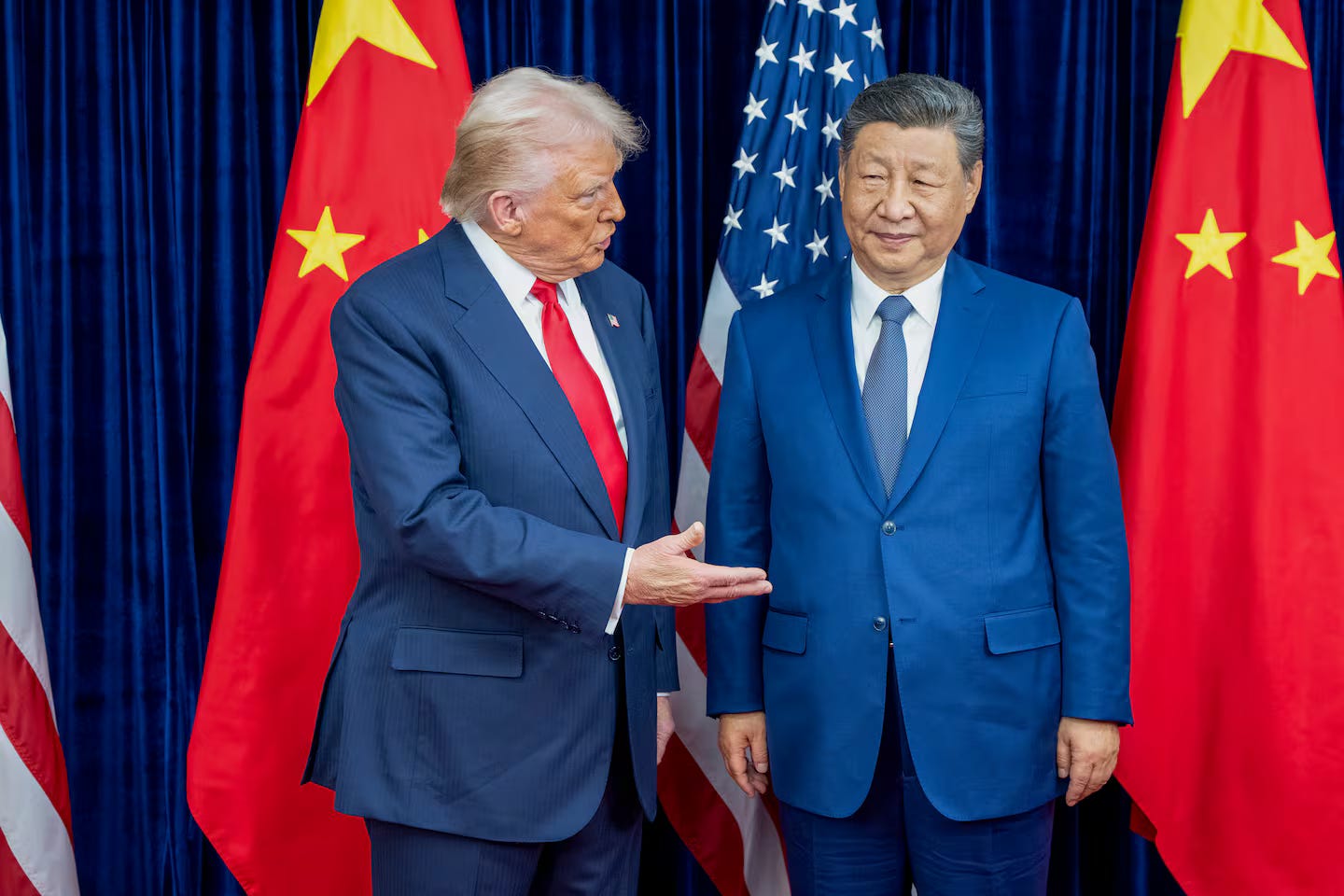
Nearly three decades later, as Donald Trump lands in Beijing for his rescheduled state visit this week (postponed in March), China is updating the script: the United States may still be powerful, but it is no longer indispensable alone.
That, at least, is how some in Chinese media are framing Trump’s visit, which comes at a time when the US is caught up in Iran and, more broadly, is upending the global order it was once eager to lead. In that uncertainty, Beijing has become a go-to diplomatic destination for NATO members. The leaders of Canada, UK, France, Germany, and Spain are just a few who have traveled to China in the past six months. This does not mean China has replaced the US, but it does signal that the West is looking beyond Washington.
At the same time, US-China relations remain tense over trade, critical minerals, and Taiwan.
The pro-government Chinese outlet Guancha has run a few op-eds (all by men)—one claiming that Trump is coming to China for a “good fortune boost” and another how Trump lands in a China that “no longer looks up to the United States.” In Caixin Global, Xu Heqian argues that China no longer stands in America’s shadow—and that Trump will land in a China that believes time and global momentum are on its side.
In scanning official Chinese channels, the government is much more subtle. It has said it seeks to work with the US on “more stability.” On Monday, Chinese foreign ministry spokesperson Guo Jia-kun said that “President Xi Jinping and President Trump will exchange in-depth views on major issues concerning China-US relations as well as world peace and development,” dropping in that this is “head-of-state diplomacy.”
Trade
For Trump, this trip is out of necessity, not diplomacy. He needs things from China. More specifically, he needs China to buy things.
Trump and Xi last met at the 2025 APEC summit in Busan, where they worked out a trade truce. The US would ease tariffs on China (which were at 145%) and China would continue to buy US soybeans and other products, not impose export controls on critical minerals, and cooperate on curbing fentanyl production. As Brookings Fellow Patricia Kim points out, those things will once again be high on the agenda this week. Former US Ambassador to China Nick Burns pointed out on the latest Foreign Affairs podcast that the lead cabinet official preparing the summit is US Treasury Secretary Scott Bessent—not Secretary of State and National Security Advisor Marco Rubio. (I am curious what Rubio does exactly?)
Trump has floated something called the “Board of Trade”—where the US and China would figure out what products to trade tariff-free, with the goal of reducing China’s trade surplus with the US. Over at the Atlantic Council, Melanie Hart points out that this doesn’t address one of the biggest challenges US businesses face in China: market access. The Economist is also skeptical, noting, “China’s trade imbalance with America arises because China produces many more things that America wants than America does that China wants.”
Critical Minerals
The Board of Trade also doesn’t touch on another sensitive area for the US and China: critical minerals, which are essential to the production of smartphones, electric cars, AI data centers, and advanced weapons systems, such as missiles and drones.
China controls 90 percent of the world’s critical mineral refining and processing. Heidi Crebo-Rediker notes that this gives Xi an advantage, especially as the US looks to replenish missile systems, interceptors, and precision-guided munitions—all of which are being used in the war with Iran. Oh yes, the war in Iran was inevitably going to come up on this trip. But let’s stay on track here… The deal that Xi and Trump signed in Busan expires in November. The big question is what will Xi want in order to extend it?
Taiwan
Part of that answer lies with Taiwan. This is Xi’s top priority, Bonnie Lin says. He has repeatedly talked about China’s reunification with Taiwan. He most recently emphasized it in his 2026 New Year’s address saying that it was “unstoppable.” The problem is the US position, which has long been “strategic ambiguity”—recogizing “one China,” as the Chinese Communist Party insists, while also supporting Taiwanese defense. Xi wants the US to move away from doing so. There is a $14 billion arms deal with Taiwan awaiting Trump’s approval. Trump said that he would discuss that with Xi this week. Yes, you can hear the gasps in Taipei—and Brussels. US security guarantees may morph into bargaining chips.
Over at the Stimson Center, Yun Sun notes that there is more. Xi wants to see the US say that it opposes Taiwan’s independence and even that it supports “the peaceful unification of Taiwan.” And Xi is willing to trade for it.
“It is crystal clear that Beijing is eagerly looking for some type of trade to negotiate the words out of President Trump, even if it does not equate to a change of US policy toward Taiwan, a position Washington has repeatedly emphasized.”
This is the clearest example of Beijing testing whether the “indispensable nation” has become a negotiable one.
Iran
Will one of the things Trump trades is China pressuring Iran? With gas prices rising and the midterm elections approaching, Trump is eager to show a “win” on Iran. And, much to his chagrin, he’s figured out that he, despite having a mighty military, can’t solve this alone.
Iran’s leaders understand this and are holding firm on their demands, which include not giving up the enriched uranium or giving up its nuclear program entirely. Given that China is one of Iran’s allies, taking in a significant amount of oil, it is the one country that can twist the Islamic regime’s arm. Beijing is eager to see the Strait of Hormuz open again and has made clear that it does not support Iran’s claim over the waterway.
But Yun Sun notes, “China does not have the ability to force Iran to accept terms that are detrimental to Tehran’s national interest.”
If that’s the case, Xi is likely to hold back on getting involved.
Jimmy Lai
The other thing Xi is likely to hold back on is the request to release Jimmy Lai. Lai is a 78-year old pro-democracy advocate and Hong Kong based media mogul. China arrested him on spurious charges of foreign meddling and violating national security. He was sentenced to 20 years in prison in February.
Trump says he will ask Xi to release Jimmy Lai. He should. But gauging from comments coming out of Beijing before Trump lands, where the Xi government has reiterated its “firm support” for Hong Kong courts, this might end up at the bottom of the pile—”didn’t get to it.”
Indispensable, together
That would be quite the change from 2012,when the blind human rights activist Chen Guangcheng escaped house arrest and sought refuge in the US Embassy in Beijing. Hillary Clinton, who at the time was Obama’s secretary of state, was in China for the US-China Strategic Economic Dialogue. But instead of talking economics, Clinton pressed Chinese officials to let Chen and his family travel to the United States. And they did—begrudingly.
Begrudgingly may also come to describe how Trump leaves Beijing: with some Chinese promises to buy more soybeans and a few Boeing airplanes and to continue to cooperate on critical minerals. The US president is unlikely to get the other items (Iran, Jimmy Lai, and meaningful cooperation on AI, which there’s just not enough space to get to) on his wish list however—simply because he doesn’t, as he would put it, “hold the cards”—vis à vis China.
The US may still be essential to the global order. But Trump’s trip to Beijing will show that it is no longer indispensable by itself.—Elmira