

Letters from an American Mother
MAGA says it wants women to have more babies, but advocate for policies that repress women. In Moscow, Putin is having a bad Victory Day. And the US and Iran seem to be close to a pause.

Sunday is Mother’s Day in the US (and Turkey!). Wishing all the moms a happy day. And speaking of moms, there’s been a lot of talk about birthrates—particularly among the right. I’ve previously written about the pronatalist movement (and have removed the paywall).

This week, I’ve handed my pen over to Varina Winder. Varina writes about what the movement’s real goals are.
If you haven’t had the chance, please fill out this survey—you could win a year’s membership to the online book shop Tertulia and a $20 gift certificate for a book from the Interruptrr book list.
I’ll be back in your boxes on Tuesday with a deeper dive into Trump’s trip to China, which is next week.
Would love to know what you think, or what I got wrong or left out— here’s my email. —Elmira
This Week in the World.....

On my radar...
Let me get this strait….
It’s really difficult to reflect on what’s happened in the past week on Iran, since it’s changed several times. And I’m not alone, the NYT, FT, and WSJ lead with something other than Iran on Friday, May 8.
We went from “Project Freedom”—the US military pledged to help foreign ships stuck in the Strait of Hormuz. By Wednesday that was over too—after Saudi Arabia and Kuwait protested the move. The WSJ scooped that both Gulf monarchies blocked the US from using its air bases for the mission. So, Trump flipped the script, claiming that the US and Iran were “close” to a deal.
That “deal,”according to Axios, is a one-page “memorandum of understanding” that would pause fighting, reopen the Strait of Hormuz and start a 30-day period of negotiations. Iran would have to agree to halt its nuclear enrichment, but not give it up entirely or hand over the material it has—a shift in the Trump position—in exchange for phased sanctions relief. We’re all waiting for Iran to respond.
In the meantime, Iran and the US exchanged what Trump called “a love tap”—both attacking one another on May 7. That got Emmanuel Macron excited…(Sorry, I couldn’t resist) Trump insists that the ceasefire is still intact. Now, what will Iran do?
To start, as this Al Jazeera piece outlines, the MOU for negotiations is exactly what Iran has been demanding—sequencing the reopening of Hormuz and then talking about nuclear enrichment. This is something the Iranians could accept—and agree to sit down for talks. But that doesn’t mean this will end the war, especially if Iran feels any proposed agreement is one-sided.
This leads nicely into this piece by Jenny Williams, which argues that holding onto the belief that military and economic pressure on Iran will bring it to its knees is a “strategic illusion”—and will only lead to a war of attrition. (Middle East Monitor)
And before I switch over to Russia… Iranian human rights activist and Nobel Laureate Narges Mohammadi is in critical condition. (AP)
As Ruqaiyah Najjar notes, “the world has a nasty habit of discovering brave women once it is time to mourn them. Let’s not do that here.”
Victory Day….
May 9 is Victory Day in Russia, marking the Soviet victory over the Nazis in 1945. For the past two decades, Russian President Vladimir Putin has made a BIG DEAL of it, putting on a big military parade, replete with tanks, missiles and soldiers, in Red Square. Not this year. He’s scaled back the event—cause that’s what happens when you grossly miscalculate your chances of winning a war that is now more than four years old and has strangled your economy and you’re a megalomaniac. It will NOT have any military hardware on display, writes Veronika Melkozerova. (Politico)
Not any from Russia, that is. Eager not to spoil his parade, Putin declared a unilateral ceasefire with Ukraine for May 8 and 9. Ukraine declared a ceasefire for May 5 and 6, which Russia ignored. Meanwhile, Ukrainian President Volodymyr Zelensky has hinted that Ukraine might launch drones during Vladimir Putin’s planned Victory Day parade.
Moscow has also shut down airports and shut down the Internet in the country. (Iran has been doing this since early March). I guess Putin didn’t like what Victoria Bonya had to say on Instagram. The beauty influencer went viral for a post in which she addresses Putin directly, noting that “people are in fear of you..Yet we should not be.” She goes on to say that she’s not afraid of him, probably because she doesn’t live in Russia. Nadezhda Azhgikhina asks if this is the start of a women’s uprising, just as they did in 1917, which brought the tsarist monarchy down? (The Nation)
Certainly, Putin is spooked. Anastasia Stognei, Leila Abboud, and Max Seddon broke the story about how the Russian president has isolated himself over the past few months, taking refuge in an underground bunker. (FT)
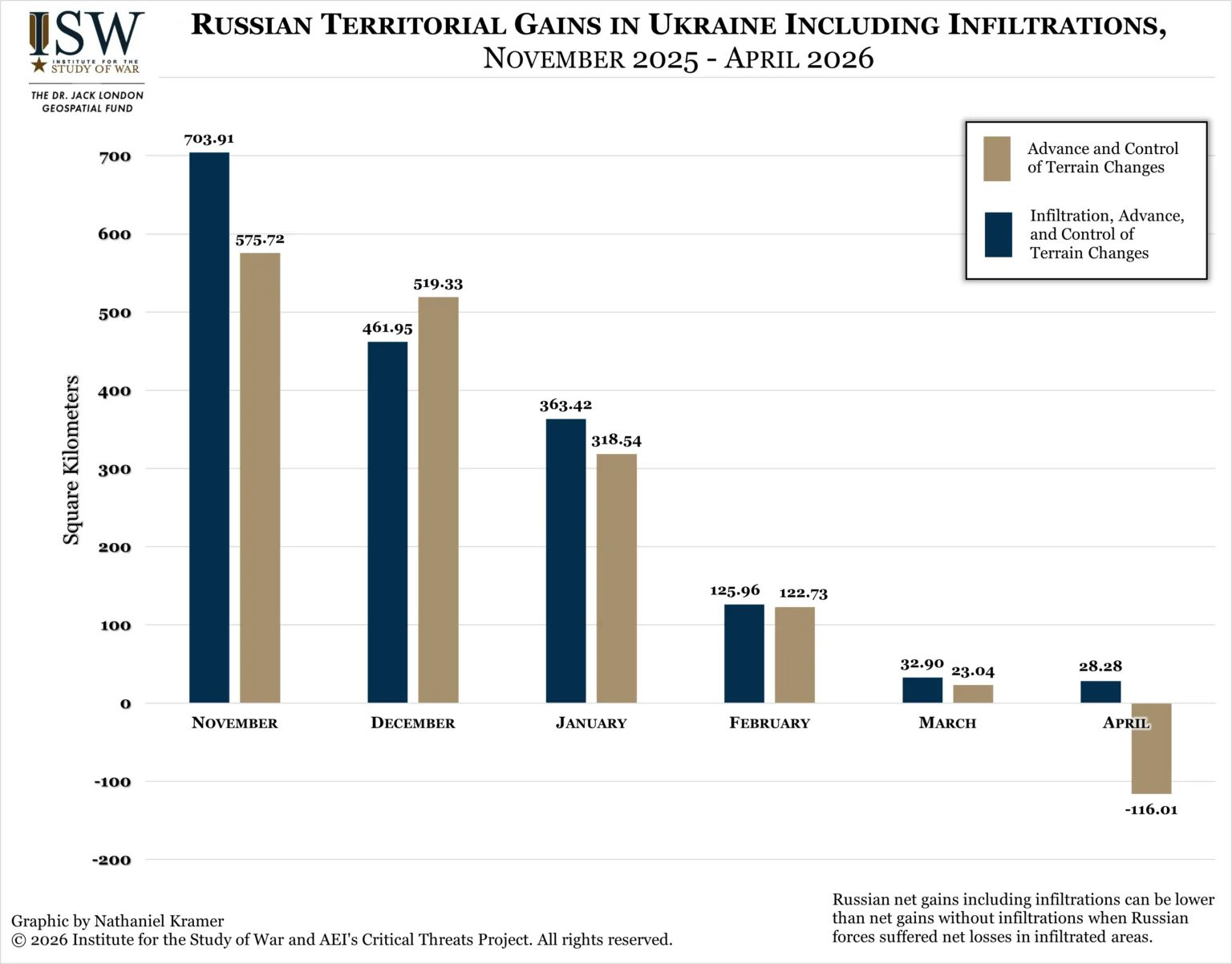
And according to the Institute for the Study of War, Russia gave up about 72 miles (116 kilometers) of territory in April. As Frida Ghitis notes, Russia still holds 19 percent of Ukrainian territory, but any illusion that the US-Israeli attack on Iran would be a boost for Moscow has been tampered with Ukrainian persistence—playing a bad hand exceptionally well. (Insight)
RightsCon
Donald Trump will head to Beijing next week. I’ll have a more in-depth look at this next Tuesday—a special edition! For now, something Trump probably won’t bring up, but should: Why China pressured Zambia to cancel RightsCon, which was supposed to take place May 5-8. This is an annual gathering started in Silicon Valley in 2011 focused on human rights and technology. Isabel Choat notes that the Zambian government had been enthusiastic about hosting the event. But China, which has poured billions into Zambian mining, was not happy that Taiwanese activists would participate and pressured the government to cancel it at the last minute. (Guardian)
This should be worrying for human rights activists everywhere.
BRICS foreign ministers meeting
While Trump meets Xi in Beijing, foreign ministers of the BRICS+ countries will convene in New Delhi. That’s Brazil, Russia, India, China, and South Africa plus a number of others, including Iran, which joined in 2024. Iran has called for the grouping to condemn the US and Israel. It has not. That has caused many to dismiss the body. But Rushali Saha argues that this upcoming meeting might be a turning point. The war in Iran has “revealed deep reservations among Arab countries about Washington’s reliability as an economic and security partner.” That makes BRICS an attractive alternative. (The Interpreter)
Hantavirus
If the hantavirus outbreak on the cruise ship has freaked you out, you should be. Apoorva Mandavilli reports that “because of deep staffing cuts the Trump administration has made to the CDC and other health agencies, the government has far fewer people to respond to outbreaks, from trainees and contractors who can be deployed to do boots-on-the-ground epidemiology to senior leaders who can coordinate responses across the US government and elsewhere. And because President Trump withdrew the country from the World Health Organization, the United States does not receive regular information from member states about emerging health threats.” (NYT)
Africa
Eritrea is feeling good this week. Sitting on the Red Sea, just across from Saudi Arabia, the US is lifting sanctions that have been in place since 2021, following Eritrea’s support for Tigrayans in northern Ethiopia. This is certain to make Ethiopia’s government, led by Nobel Laureate Abiy Ahmed, think twice about escalating tensions in the Tigray region, as it has been for the past few weeks. Ahmed, as Giulia Paravicini points out, has said that his nation has “a right to sea access.” (Reuters)
The Nobel committee awarded Abiy Ahmed the Peace Prize in 2019, for ending Ethiopia’s border conflict with Eritrea. #Awkward
In Mali, the militant attacks that killed the defense minister have exposed the military government’s failure, alongside Russia’s Wagner Group, to stabilize and secure the country. Oge Onubogu points out that counterterrorism alone will not solve Mali or the wider region’s extremism problem. Military violence cannot be separated from political fragmentation, local grievances, and governance. (CSIS)
You cannot bomb your way out of terrorism.
Asia
In India, Narendra Modi’s ruling Bharatiya Janata Party (BJP) made significant gains a state assembly elections this week in West Bengal. It has been an anti-Modi holdout, with a woman who has been outspoken against the Indian prime minister, Mamata Banerjee. She’s been West Bengal’s chief minister since 2011. Manoranjana Gupta notes that after 15 years, voters were growing tired of her. BUT, she notes that it wasn’t merely anti-incumbency that led BJP to turn things around in West Bengal, but how BJP has been bending India’s electoral system around it. The party did push to purge voter lists. (Eurasia Review)
This is interesting to watch, especially since BJP lost seats in parliament in general elections in 2024. For her part, Mamata Banerjee says she will not give up her seat, claiming electoral interference.
The Americas
Right after meeting with Pope Leo, on what has been dubbed as an apology tour, US Secretary of State Marco Rubio announced more sanctions on Cuba. Way to empathize with fellow Catholics, who happen to be suffering, Marco. Sophie Brams notes that these sanctions target Grupo de Administracion Empresarial SA (GAESA), which the Cuban military controls. GAESA controls 40 percent of Cuba’s economy. (The Hill)
Though there has been a lot of speculation that the US will soon invade Cuba, Polymarket seems to be cool on the matter.
In Canada, the oil-rich province of Alberta could hold a referendum on breaking away from the country. Separatists have collected more than 300,000 signatures to put the matter to a vote. Chantelle Lee notes that despite the enthusiasm, it’s unlikely to pass. (Time)
And Donald Trump isn’t the only problem Claudia Sheinbaum has. Mexico City is sinking. Fernanda Gonzalez has more. (Wired) 😳
Middle East
It’s not shocking that homes get destroyed in war. It should be. Interruptrr Fellow Fayrouz Saad reflects on the destruction of her family home in southern Lebanon. (NPR)
The United Arab Emirates signed on to the Abraham Accords back in 2020. After the US-Israeli attack on Iran on February 28, Israel sent missile interceptors to the UAE—the first time it had sent equipment from its “Iron Dome” capabilities elsewhere. Lisa Goldman on why the UAE is “all-in” on Israel. (New Lines)
Europe
Last week, German Chancellor Friedrich Merz, who marked one year in office this week, said that the US was being humiliated in Iran, which is true—and most definitely a comment that ticked off Trump, who had already been ticked off that Europe has not supported his war on Iran. So ticked off that last Saturday, Trump announced that the US would pull 5,000 troops from Germany. There are about 35,000 US troops stationed in Germany and 40,000 throughout Europe, so that would still leave about 70,000 US soldiers on the continent, as outlined in the 2026 National Defense Authorization Act. What Liana Fix says is more concerning is “the cancellation of the long-range Tomahawk cruise missiles that are to be stationed in Germany in 2027—the first stationing of long-range, ground-based missiles in Germany.” (CFR)
The Gender Tracker
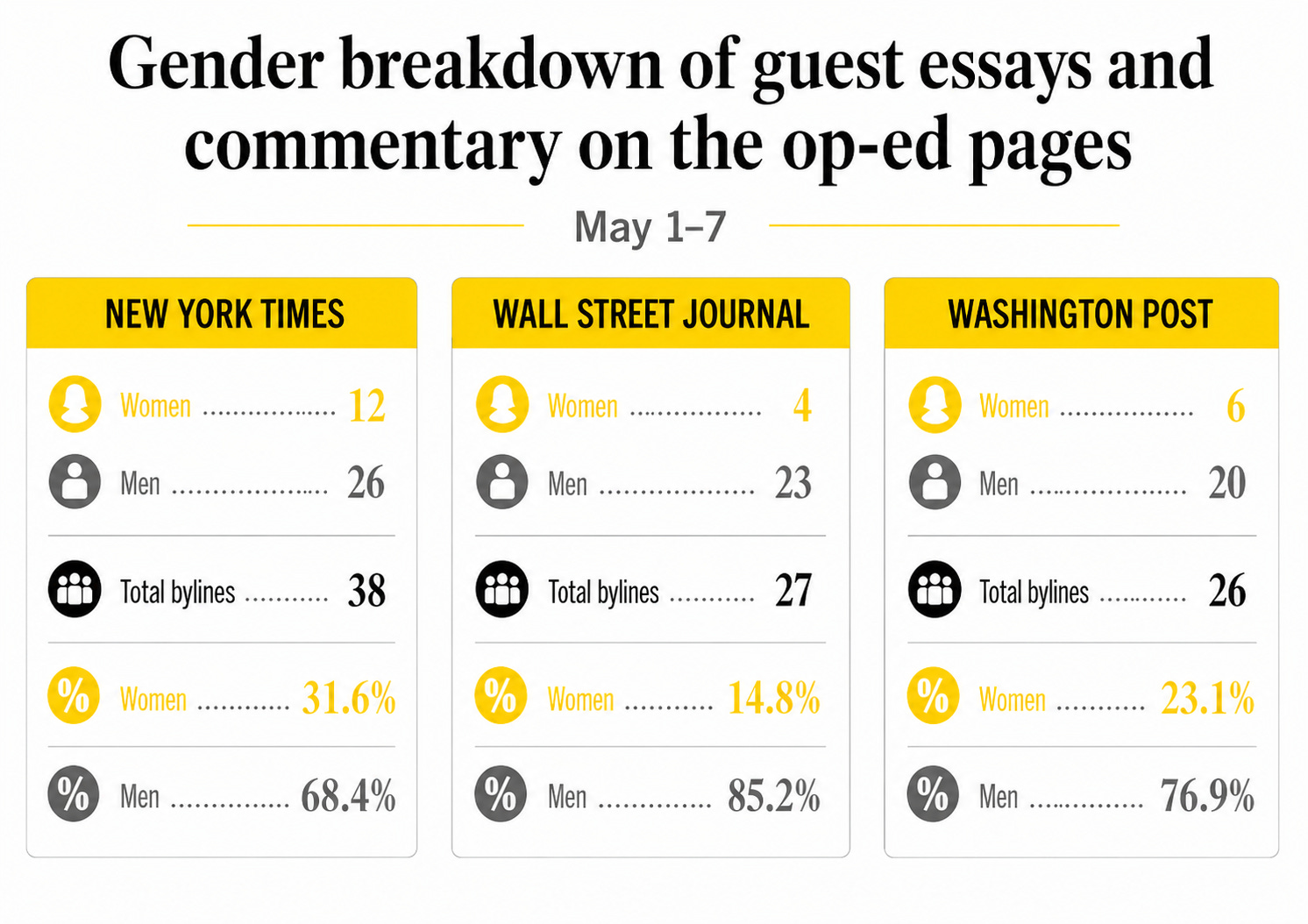
What was the gender breakdown on the op-ed page this week? There’s improvement. There was an uptick in the NYT (from 8 women to 12) and Washington Post (from 3 to 6). In terms of content, in the NYT there were pieces on the Supreme Court, Cuba, and NATO. In the WSJ, three out of the four pieces focused on foreign policy. In the Washington Post, two pieces focused on foreign policy. Also at WP, Julia Cartwright had two bylines, but counts once. Still, men make up an overwhelming majority of bylines on the op-ed page.
Thanks for the positive response to this—and the request to include platforms, including podcasts. I’m working on it. 😉
Friends of Interruptrr
If you enjoy Interruptrr, you may also enjoy The Dial. An award-winning online magazine, from an all female editorial staff, The Dial publishes the best investigative reporting, essays and literature from beyond the Anglosphere. What's happening in China’s “fake offices”? What is it like to go into exile for your reporting? Does Duolingo really work? Sign up for their weekly newsletter to receive their stories in your inbox.

Opportunities
In NYC, the Mayors Migration Council is hiring for a Director, Communications, Knowledge, and Impact.
CFR has a number of interesting positions, including Deputy News Editor.
Global Witness is on the hunt for a CEO.
Over at the Bulletin of Atomic Scientists, there’s a search for an Editor-in-Chief.
Postscript
This is a guest post by Varina Winder.
I started writing letters to my children before they were born. A letter when I found out I was pregnant. Another the night before I returned to work. Always one on each birthday. I seal each one in an envelope, label it, and tuck it away. These letters started as an outpouring of love, then a record of firsts—words, foods, best friends, bike rides, books— and losses, teeth, stuffies, and a beloved dog. Lately, they’ve become a place where I record my worry and fear that they are growing up with fewer choices I had.
My children are growing up in a country that says it wants more children. There is a rising pronatalist movement—composed of big tech titans, think tanks, and government leaders—that claim the American birth rate is unacceptably low, and that women are to blame. The total American fertility rate – the average number of children a woman has over a lifetime – is 1.6, below the replacement rate of 2.1. This downward trend mirrors that of other highly developed nations, where economists and government leaders alike are concerned about aging populations and a shrinking ratio of working-age adults to dependents.
Yet, none of the policies being promoted—marriage incentives, abortion bans, contraception restrictions, and campaigns to push women out of the workforce— will make it easier for Americans to form families, have children, or support them. Instead, they are a Trojan horse to strip Americans of their rights. In many cases, these “solutions” make it harder to have children – and decimate lives in the process.
The evidence is clear. The Heritage Foundation recently proposed a series of new entitlement programs to incentivize heterosexual marriage as way of increasing birth rates, using Hungary as a model. Despite spending 5.5 percent of its GDP on programs meant to boost marriage, Hungary saw only a brief rise in birth rates – from 1.3 to 1.68 – before it fell again to 1.3 two years later. Romania offers an even darker warning. Its draconian ban on abortion in the late 1960s briefly boosted fertility rates, while causing a maternal mortality rate ten times that of its neighbors and leaving almost 200,000 children abandoned to overrun orphanages. The fertility rate dropped again as women found ways to prevent and terminate pregnancies, and when communism fell in Romania, the abortion rate became one of the highest in all of Europe. Iran’s 2022 ban on sterilization and the provision of contraception follows a similar pattern: it has not increased the fertility rate, but has increased unsafe abortions as well as maternal and child mortality. As the US federal government turns away from supporting contraception, 19 million women and girls aged 13-44 already live in “contraceptive desserts.” Just last week, the Fifth Circuit banned the mailing of mifepristone, ensuring that women living in states with abortion bans endure even more obstacles to accessing safe health care.
These are not the only regressive policies the Trump administration and its MAGA allies are pursuing. They have reclassified majority women’s jobs as “nonprofessional,” proposed testing public water for mifepristone, and sought to broaden covenant marriage. They have cut Temporary Assistance for Needy Families (TANF), Medicaid, SNAP and Head Start. At the same time, those on the hard right happily provide financial support for “trad wife” influencers, campaigns to reject birth control and “repeal the 19th.” Taken together, it is alarmingly clear what the true aim is – full control over women’s bodies, women’s finances, and women’s choices.
If addressing low fertility was the goal, the government and its allies might instead focus on the primary reason Americans are choosing to have fewer children: affordability. According to Brigham Young University’s 2025 American Family Survey, more than 70 percent of Americans believe that raising children is too expensive, and reported that “insufficient money” was (by far) the leading reason they were limiting their own family size. Decades of data from high income countries that do enjoy relatively stable fertility rates, such as the Nordics, France, and Estonia, show that governments that invest in families make it easier to have children. These nations have pursued policies like universal health care, including access to high quality reproductive care, expanded and affordable housing, paid parental leave, universal child care, marriage equality, free higher education, and direct cash support.
They have invested in seeking gains for their citizens, not in locking in generational loss. Their goals are to increase freedom, not erase it.
When each of my children becomes an adult, I will hand them my stack of letters. I hope they will read a story not just of my intense love for them, but a story about finding renewed optimism and hope against this coordinated push to end their freedoms. I hope they marry for love, find work that interests them, have the means to support themselves and their loved ones. My government says it wants more children. If I get to have grandchildren, I hope I hold babies conceived of their parents’ own, deeply personal choices. I will write letters to them, too.—Varina
Varina Winder is the co-founder of the Arch Collaborative, a five-year strategic initiative focused on resisting the anti-rights movement and (re)building for a world in which gender equality is non-negotiable. She was formerly Chief of Staff and Senior Advisor in the Secretary’s Office of Global Women’s Issues at the US Department of State.

 |
|