

MOU: More Optics than Understanding
The Trump-Iran MOU misses the point, especially when you compare it to Obama's JCPOA. Andy Burnham wins. Colombia votes. And the Gender Tracker sees some improvement...

Honoring Juneteenth and wishing all the dads out there a happy papa’s day. Happy birthday Heather! Congrats to Maude and Zola, high school grads….🎓
And CONGRATULATIONS TO THE NBA CHAMPIONS THE NY KNICKS. 🙌 💙🧡
Would love to know what you think, or what I got wrong or left out— here’s my email.
This Week in the World.....

On my radar...
Trump’s “memorandum of understanding” (MOU) with Iran is the big story of the week, even though as of Friday morning, June 19 all of it seems in jeopardy as Israel has resumed attacking Lebanon, despite the MOU’s language calling for an end to hostilities on all fronts. JD Vance had been set to travel to Geneva for the start of talks with the Iranians. He has cancelled. It’s increasingly looking like the challenge is how to control Benjamin Netanyahu and the far right in Israel rather than the Islamic hardliners in Iran.
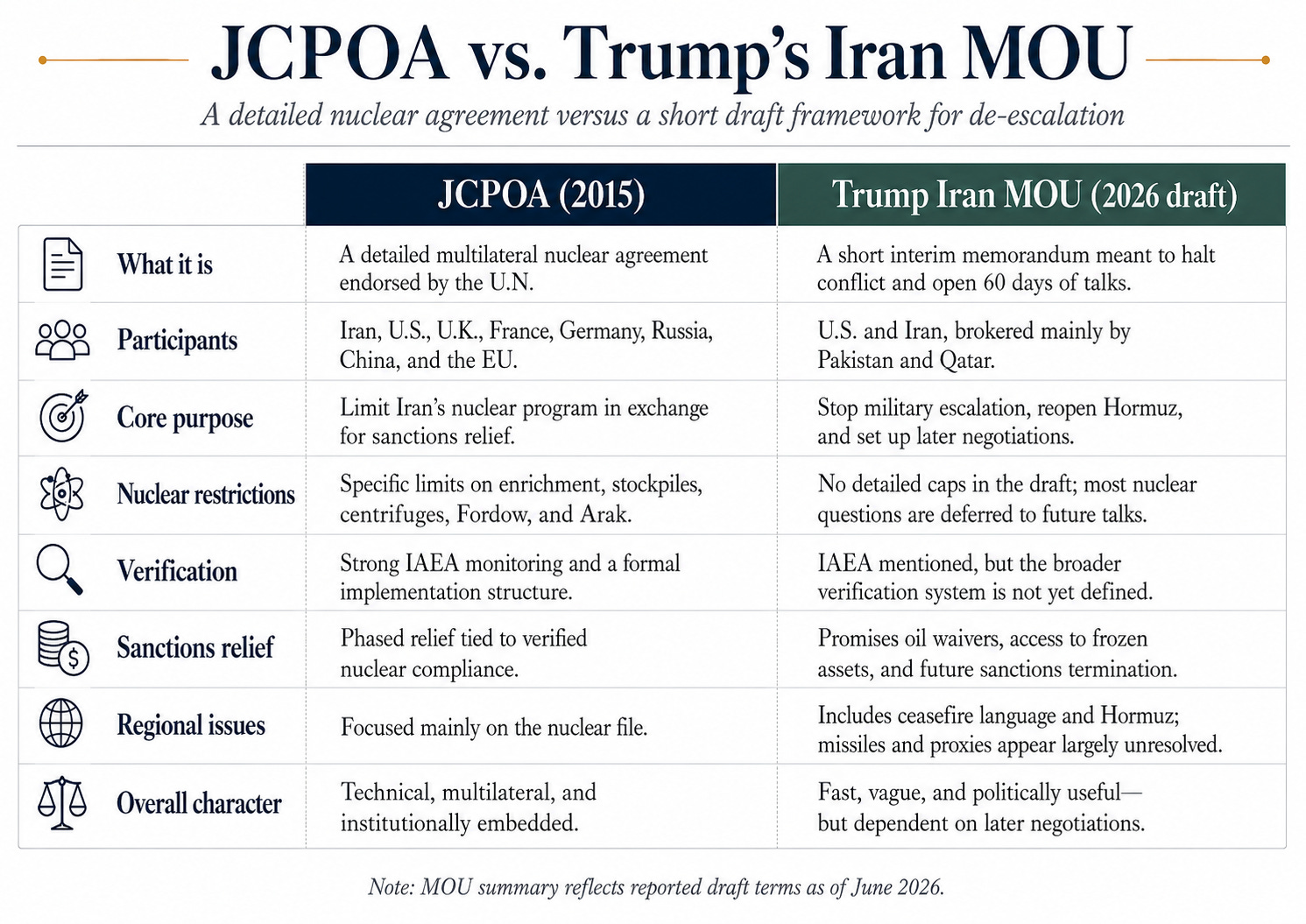
Going back to the MOU… Ending hostilities is at the core of the Trump-Iran MOU—not Iran’s nuclear enrichment or capabilities. Trump, in one of many justifications a few months back, claimed to have launched the war in order to prevent Iran from developing a nuclear weapon. That is what was at the heart of Barack Obama’s Joint Comprehensive Plan of Action (JCPOA), ironed out over 20 months and signed in 2015.
The JCPOA was an actual multilateral deal that brought in Europe, Russia, China, the EU, the International Atomic Energy Agency (IAEA), and the UN. It focused on Iran’s nuclear question: how much uranium Iran could enrich, what facilities it could operate, what stockpiles it could keep, how compliance would be verified. All of that would then result in sanctions relief amounting to about $1.7 billion—which Trump heavily criticized.
Trump’s MOU offers immediate oil waivers, access to frozen funds, and the possibility of a massive investment package. You might have seen $300 billion being bandied about. That’s not a check to Tehran, but a reconstruction fund Iran would draw on, not contingent on nuclear capabilities but ceasefire compliance.
And the ceasefire is what is at the heart of Trump’s MOU; it does not focus on Iran’s nuclear capabilities. It is focused on ending the fighting and reopening the Strait of Hormuz—undoing the things that Trump set in motion. In lieu of a column, I opted to compare the JCPOA and the MOU. It speaks for itself.
A number of links:
The war on Iran has left Iranians worse off “on every front,” writes Holly Dagres. (MS Now)
Listen: America might be a stronger nation, but Iran has been the long suffering one. And the people who are now in charge of the Islamic Republic not only know that Iranians have tolerance to sanctions and isolation, they are young, explains Narges Bajoghli in this podcast. She’s followed on by Holly Dagres who comments on the impact of Iran’s internet shutdown for nearly three months. (Today Explained)
Trump has said that the US attack on Iran was about preventing the Islamic Republic from acquiring a nuclear weapon. Cassandra Veney pushes back, noting that Washington’s willingness to use force stems from its own legacy as a nation born out of violence that nurtured a worldview that sees challenges through a lens of dominance rather than coexistence. (The Elephant)
Over in Israel, Benjamin Netanyahu wanted the war with Iran to be about regime change, which we know has not happened. By all accounts, this MOU is a blow to him—months before Israelis will go to the polls to elect a new leader. And while Netanyahu will have to navigate that election fight, Noa Landau points out that Israel’s opposition also faces a challenge for embracing similar wishful thinking that Israel can permanently eliminate the Iranian nuclear challenge through force. (Haaretz)
Meanwhile, Israel still occupies southern Lebanon. How does Lebanon factor into the MOU? Sarah Shamim notes that it’s mentioned, citing the termination of all military operations. The only problem is that Israel isn’t mentioned. (Al Jazeera)
Israel’s foreign minister says that the country will cut off all contact with the EU’s top diplomat, Kaja Kallas. (Politico)
And to round up this section, Nitya Labh warns that the next Strait of Hormuz crisis will be worse. (Chatham House)
Andy Burnham
The other big headline at the end of this week is the special election that took place in the UK on June 18. Andy Burnham, from the Labour Party, won 55 percent of the vote, which Rosa Prince calls “stunning,” given that his main competitor was the far-right Reform party, headed by Nigel Farage. She says that the momentum he had been building may be unraveling—perhaps because of how Reform views women. Burnham is now likely to challenge Prime Minister Keir Starmer for party leadership. (Bloomberg) 🎁🔗
G7
I had forgotten that France and other G7 members moved the date of the annual summit to accommodate Trump’s birthday and his stupid UFC cage match at the White House. Babying the baby. That’s my overall assessment of the meeting. There were no walk-outs, like Trump did last year in Canada. No calls for seizing Greenland. It also didn’t solve many problems either. The meeting claimed to focus on economic imbalances but didn’t really touch the topic. But when Trump is in the room, signing his MOU with Iran, that’s probably going to be the result.
And while the Europeans are probably relieved that there is an MOU with Iran, they should be more nervous about what he’ll do on Ukraine, writes Liana Fix. Trump did meet with Ukrainian President Volodymyr Zelensky in France, But, as we’ve seen in the past, that has not been enough to bring him to turn on Russia. Fix suggests that the Europeans can’t rely on Washington to solve Ukraine and, instead, need to up defense production. (CFR)
Colombia election
Big elections in Colombia on Sunday. Voters will elect either right wing (and 47-year old) Abelardo de la Espriella or left wing (and 63 year-old) Iván Cepeda. In the first round on May 31, de la Espriella got 43.74 percent of the vote; Cepeda 40.9 percent. Analysts note that it was a difference of 670,000 votes. Our friends at Americas Society/Council of the Americas have been monitoring voter sentiment and it looks like de la Espriella has an edge.
One of the reasons de la Espriella may have an edge is the strength of the anti-Gustavo Petro sentiment, Colombia’s current leader. de la Espriella is running on his criminal law background, as a Nayib Bukele-like figure who will be tough on crime. Gimena Sánchez-Garzoli lays out de la Espriella’s platform and contrasts it with Cepeda’s. (WOLA)
While it is being cast as a race between right and left, Juanita León, says it is being framed as a battle of continuity or “fear of an authoritarian leap to the right.” (La Silla Vacía)
On that note, León founded La Silla Vacía, a Colombian media site that translates into The Empty Chair, in 2009, which has been going strong. An inspiration for Interruptrr.
World Cup
Here’s another piece that reinforces why we need female perspectives:
Earlier this week FIFA banned the Haitian team’s shirts, for depicting a key battle from the Haitian revolution—the only successful slave revolt. Julia Gaffield argues that this is part of a longer pattern minimizing Haiti’s revolutionary legacy and casting it as violence rather than liberation. (The Conversation)
So, countries like Qatar want to host the World Cup to improve their image. The Trump administration is using the World Cup to project its “toughness” on immigration and borders, writes Megan Corrarino. It exemplifies the shift from soft to hard power and the emphasis on “America First.” (Just Security)
US
If you need more evidence that the Trump administration is not ideological, but all about control: this week it announced that it would prevent anyone outside the US from accessing Anthropic’s latest AI models by imposing export controls. Emily Peck and Madison Mills report that that could harm the entire AI industry. (Axios)
Africa
The CDC reports that, as of June 18, there are 837 confirmed cases of Ebola, with 196 deaths.
The current Ebola outbreak could become the worst on record if infections are not brought under control soon, writes Ellyn Vohnoutka. (US News & World Report)
Asia
This is super interesting—and something we’re likely to see more of in the future as foreign policy breaks down at a federal level. Singapore, which is a city-state, has launched an initiative to connect mayors around the world to address global issues. Erin Liam has the story. (Channel News Asia)
Trump met with Indian Prime Minister Narendra Modi at the G7 meeting in France. He announced that he will visit India, setting off headlines that the touchy relationship between the US and India is back on track. But then the US Defense Department announced it was dropping Indo from Indo Pacific Command, at the likely urging of China.
Of note: Japan’s central bank raised interest rates to their highest level in more than 30 years.
Americas
With Iran “in the rear view mirror” will Cuba become Trump’s focus over the next few weeks? Liany Diaz Gonzalez and Brian Fonseca outline four scenarios of what a US intervention could look like: (1) humanitarian assistance, (2) military action, (3) regime collapse, (4) negotiated settlement. (Americas Quarterly)
Europe
The Swiss voted down a population cap last Sunday—but not by much. It was 55 percent against and 45 percent for, which most of the analysis says indicates a wider problem over immigration.
The UK has banned social media for minors. Lindsey Granger notes that follows a number of other countries that have done the same, namely Australia. But as Australia shows, it’s not effective, as kids find work arounds. Governments need to get tougher on tech companies. (Yahoo News)
Meanwhile, the Royal Navy intercepted a Russian tanker, the SMYRTOS, earlier this week carrying 600,000 barrels of oil. Julia Struck-Feshchenko on how Moscow evades sanctions. (Kyiv Post)
Since Kyiv was mentioned… the Cathedral of the Kyiv-Pechersk Lavra monastery caught fire after a Russian drone attack. Asya Zolinikova notes that it’s not the first time the complex has been damaged. She traces the history of the building. (Meduza)
The European Union launched the accession process for Ukraine and Moldova to join the grouping. And that has unleashed a series of questions about the EU, its process, and purpose. There’s a lot to say about that, especially as a number of other potential candidates seem to be going nowhere, namely Bosnia and Serbia. My views on the EU and Bosnia, and to an extent Serbia, are clear—the Europeans need to engage more.
On that, Iliriana Gjoni acknowledges that EU membership has become a political project—not just a technical process. She argues that the EU has spent decades preparing candidates for membership but has largely neglected preparing its own citizens for enlargement. And the problem with that is with concerns about migration, economies, and identity, bringing on more members just feeds political tensions. (Carnegie Europe)
Albanians have taken to the streets—with flamingos. They’re upset over proposed plans to build a luxury resort on a protected wetland. Trump’s son-in-law Jared Kushner is behind the project. But that’s about all we know about it. And that lack of transparency, along with corruption, is what Albanians are upset about, writes Rudina Hajdari. (Newsweek)

The Gender Tracker
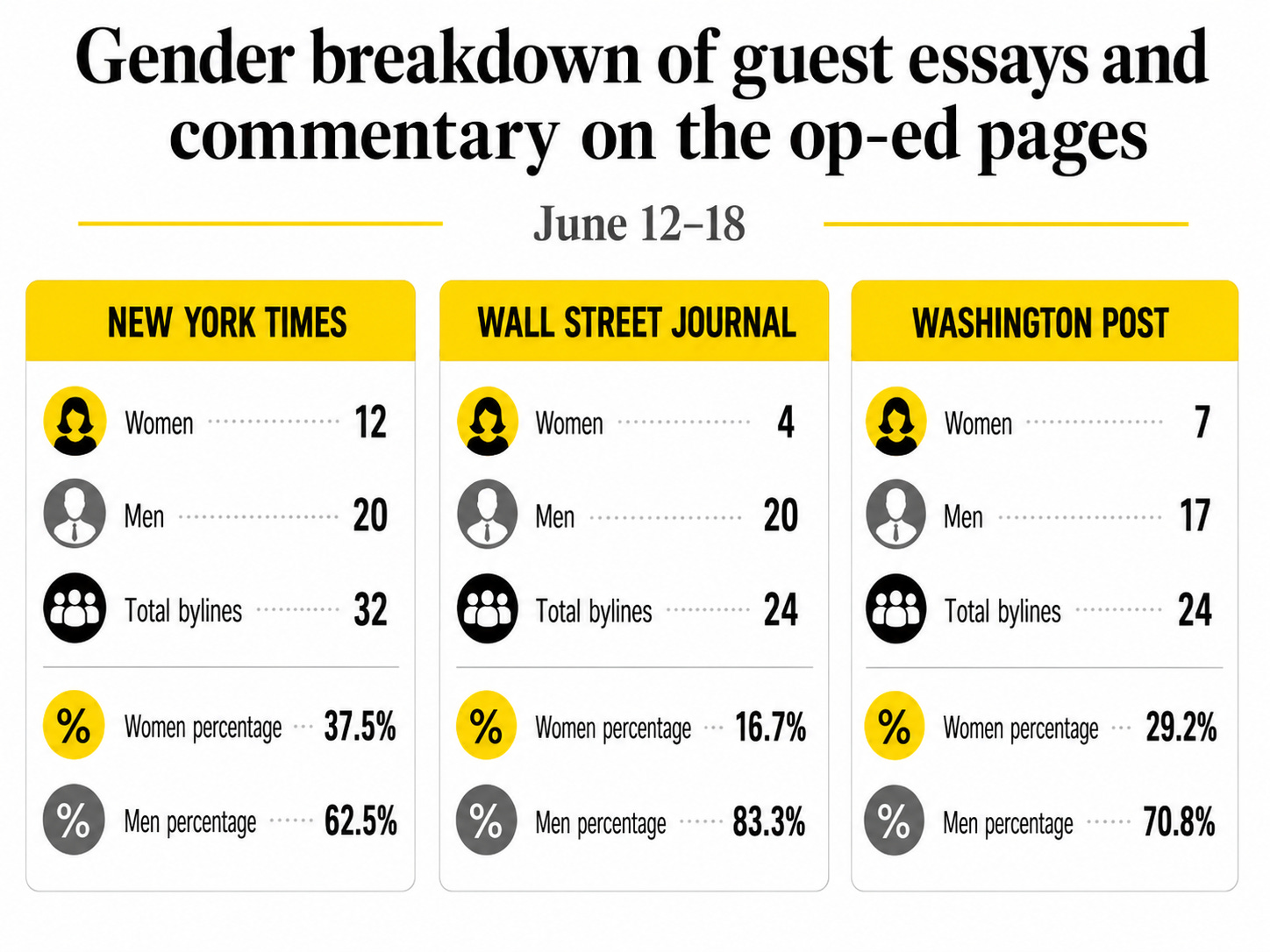
This week, the NYT had the best gender breakdown thus far, with 37.5 percent. I was pleased to see the number of women as guest contributors, commenting on Iran, Israel, and AI. There was a piece by Mireille Sileoff about how women over 50 are invisible that irked me, only because it claims that the issue is our society’s obsession with all things youth. She overlooks the fact that women are invisible because we’re not valued. The WSJ and WP average about the same, with the Washington Post consistently coming in the worst.
Opportunities
Applications for the Harvard Radcliffe Institute Fellowship Program close in September. If you’ve got a proposal for a project that addresses a “pressing social, scientific, and policy issues and seeks to engage audiences beyond academia,” this is for you.
Another fellowship opportunity: Hungarian Institute of International Affairs Future Leaders Program is taking applications through June 30.
In DC, Salesforce is hiring for a Senior Director, Government Affairs & Head of Congressional Affairs.
The podcast, Reveal, is hiring for a producer.