


Thanks to everyone who joined our chat with an editor yesterday during Interruptrr office hours. Super interesting discussion about what editors, or in this case one editor, thinks about your pitch and what keeps her interest. The next office hour is next Monday, October 19 at 12pm ET. I’ll have another perspective about writing in the geopolitics space. If you’re interested, please become a paid subscriber. It’s $8 per month or $80 or $150 per year, which you can deduct from the cost of upcoming op-ed writing workshops and a series of feminist foreign policy courses.
Sweden’s election results are still up in the air… The center left Social Democrats have a razor thin margin of about 28,000 votes over the right. I’m watching this one.
On Friday, Italian politician, feminist, and human rights activist Emma Bonino passed away. Her influence on Italy’s politics was so significant that even Giorgia Meloni, Italy’s right-wing prime minister, commented that even though Bonino sat on the opposite spectrum of politics, she recognizes Bonino’s influence. One woman really can make a difference.
That’s a good segue to today’s piece about one woman in Malta who tried.
Today, I’m particularly proud to have Anastasiia Vorozhtsova grab my pen. She is a journalist and editor at Columbia Global Freedom of Expression, where she writes a newsletter on freedom of expression violations and leads the Protest Monitor project. She previously contributed to The Daily podcast at the NYT, helping the team cover Russia’s full-scale invasion of Ukraine and the domestic crackdown on dissent. She is also a former student of mine, who wowed me from the very first class. #ProudProfessor. —Elmira
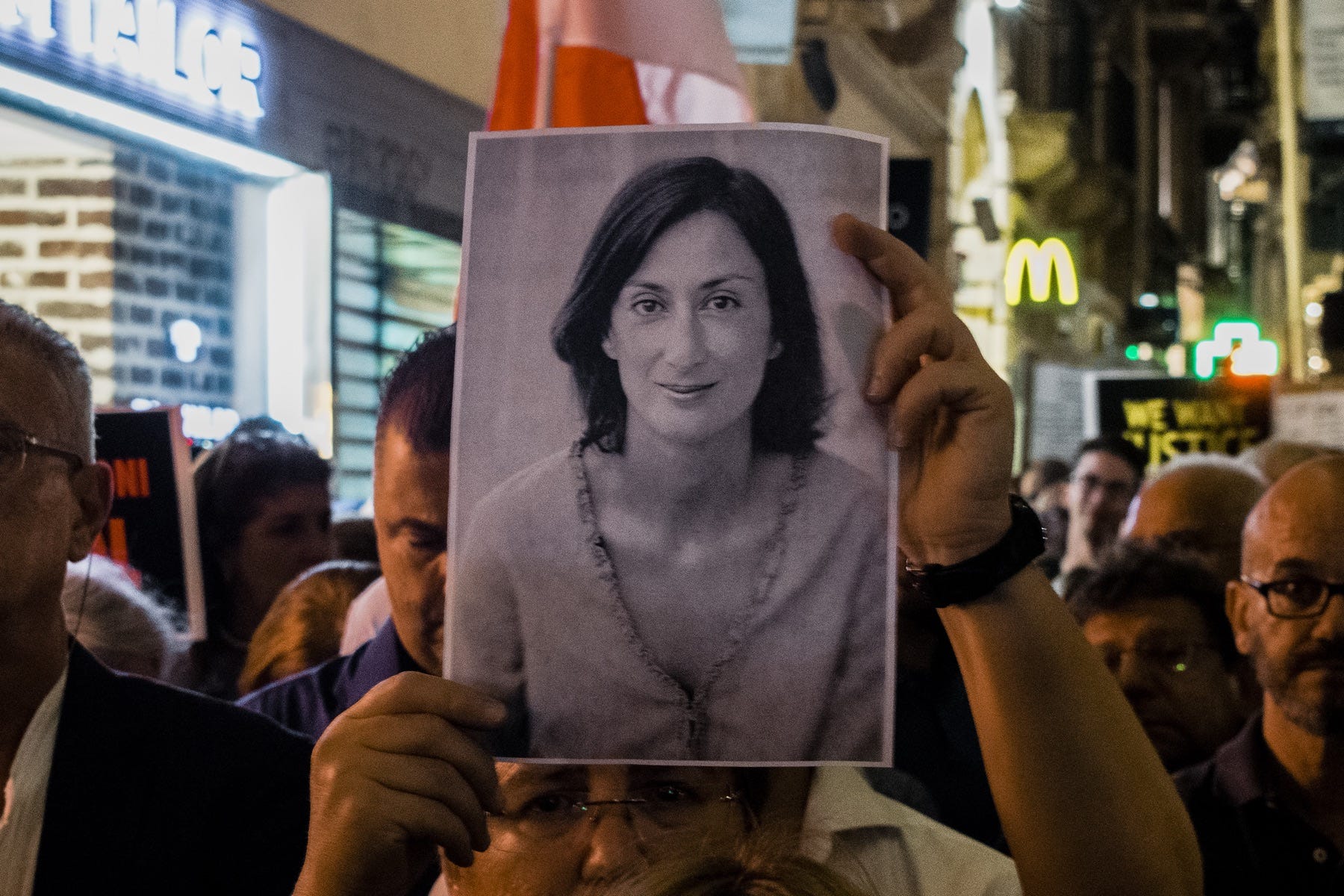
“There are crooks everywhere you look now,” journalist Daphne Caruana Galizia wrote one afternoon from her home in Malta. “The situation is desperate.” Minutes later, she rushed to go to a bank. But her accounts were frozen, as Malta’s economy minister was suing her for libel. Daphne said goodbye to her son, also a journalist. He had just moved back home—a respite amid the ostracism she found herself in—and was helping her with a major investigation. But Daphne had to sort things with the bank first. She got into her recently leased Peugeot—her old car had become too recognizable—and began driving. Seconds later, a man in a boat just off the shore in Valletta sent out a cryptic text message. The text activated the bomb in Daphne’s car.
Daphne Caruana Galizia was assassinated on October 16, 2017. She was 53 years old.
That year, Daphne came close to uncovering an elaborate fraud scheme involving Yorgen Fenech, an heir to a property empire, and top government officials. Nine years on, Fenech faced a jury trial on charges of “complicity” and “criminal association” in Daphne’s murder—Malta’s trial of the century. “If Malta has an equivalent to the Trump dynasty,” Juliette Garside wrote for The Guardian. “The Fenechs are it.” They own the Portomaso Business Tower, Malta’s tallest building until recently, that overlooks a yacht marina. They run luxury hotels and casinos. Yorgen Fenech—his head shaved clean, his glasses dark, his suit dapper—had access to the prime minister’s office. He drank with the deputy police commissioner. “Our power is the money,” he told the self-confessed middleman who testified against him. “What am I going to do, tell the judge I killed her?” the jury heard Fenech’s secretly recorded voice say.
The explosion that killed Daphne shook Malta, a tiny island nation in the Mediterranean. With a population of about half a million, Malta is the EU’s smallest member state. In “this little rock,” as Daphne described Malta, everyone knew her. The blog she published, Running Commentary, received hundreds of thousands of daily views. No Maltese newspaper could compete with that. One of the reasons is Daphne’s focus: corruption. As Malta became a backdoor to illicit wealth, Daphne pioneered financial journalism. Politico described her as “a one-woman WikiLeaks.” That is what made her the most targeted one. Maltese authorities should have been a source of support. Instead, they contributed to the abuse. After her death, protesters, most of them women, repeated Daphne’s last written words, “There are crooks everywhere you look now. The situation is desperate.”
On September 2, after two months of marathon proceedings, Yorgen Fenech walked out of the courtroom as a free man. In an 8-1 decision, the jury acquitted him on both charges. The verdict came as a shock. For Daphne’s family and others campaigning for the safety of journalists, the past nine years were a gruelling fight. Having promised justice, the trial only showed that impunity persists—for Daphne, her family, Malta, and other journalists, particularly women, around the world.
Daphne Caruana Galizia became Malta’s first independent columnist to publish under her own name in 1990. She was also the country’s first woman columnist. Back then, the island’s only English newspaper was not allowed to employ women, and 25-year-old Daphne began publishing her columns as a freelancer. “But does your husband write them for you?” people asked her. “Does your father?” Daphne forged her path in journalism with no role models around and all while being a mother of three. Her writing—direct, vivid, caustic—earned her many devotees.
Not everyone agreed. Her son Paul writes in his book A Death in Malta that Daphne’s editor dealt with private complaints: “Who is she, at the end of the day? Does she know what she’s saying?” Four years later, in 1993, Daphne published her first major exposé, forcing an army brigadier to resign after his son was arrested for drug trafficking. It was then, Paul recalled, that Daphne received the first serious threat and started checking the underside of her car every morning before she took her sons to school. A year later, someone killed the family’s dog. Soon after, someone set their front door on fire.
Daphne kept writing. After Malta officially joined the EU in 2004, she followed the nation’s slide into a rule-of-law crisis. Malta failed to reform its institutions to tackle corruption and clientelism. With direct access to a much larger market, both reached new levels. Through cash-for-passport and tax evasion schemes, vast sums of illicit foreign funds flowed into the country. “Like the officials who went from soliciting bribes from drug dealers in old Malta to soliciting them from oligarchs in hyper-globalised Malta,” Daphne’s son Paul wrote, Daphne transitioned “from reporting on low-level Maltese corruption to grand corruption.”
As democracy eroded, the campaign against Daphne intensified. In 2006, someone splashed graffiti on a wall by the road leading to where she lived. Three days later, arsonists set her house on fire in the middle of the night. After Daphne launched her blog in 2008, tens of thousands of trolls began smearing her. On the eve of the 2013 general election, Daphne was arrested for an article critical of Labour Party leader Joseph Muscat. A few days after Muscat won in a landslide, a pro-Labour mob led by the mayor of the town Żurrieq chased her at a nearby village feast.
Under Prime Minister Muscat, corruption peaked in Malta, as did the efforts to silence Labour’s fiercest critic. Secret anti-Daphne, pro-government Facebook groups had tens of thousands of members. They included Prime Minister Muscat and other top officials. An aide to Muscat ran a blog with the sole purpose of denigrating Daphne: he would go as inhumanely low as he wished.
Daphne exiled herself to her home and garden. She slept less, ate more, and felt isolated. Still, she kept writing. “In one way, she stopped caring,” Paul wrote. “In another, her self-exile gave her a bigger stake. She could write even more freely and honestly [...].”With Malta’s institutions failing one after another, people turned to her as one of the few remaining venues to expose wrongdoing.
“Look at what they call me most, a witch,” Daphne said ten days before her murder. “If I were a man, would they call me a witch? No!” In that interview, she reflected that being a woman solidified antipathy towards her. Be it the 1990s or 2010s, in Malta, who dared to critique those in power mattered. “And obviously a lot of the people I was criticizing […],” Daphne went on to say, “were men—hardly any women. So, you know, ‘What do you mean, a woman criticizing a man?’ And the men react really badly! And even till today, 27 years later, they react viciously.”
In that interview, Daphne was sure the harassment she suffered was deterring other women from public life. Nearly a decade later, how many voices still go mute? A 2026 study of online violence reported that 45 percent of women journalists and media workers self-censor globally—the number has doubled over the past five years. And how many women choose not to pursue journalism in the first place? The true toll is notoriously hard to measure.
“The murder of a journalist does not happen out of the blue,” Pavol Szalai of Reporters Without Borders told me recently. In the case of Daphne, the EU should have acted earlier. At the time of her murder, Daphne was facing 48 abusive lawsuits and non-stop smearing, cyber-bullying, and surveillance. The killing of a journalist inside a member state took the bloc by surprise. Daphne’s death forced the EU to acknowledge Malta’s rule-of-law crisis and mount political and institutional pressure that would eventually lead to Muscat’s resignation in 2020. A public inquiry, for which Daphne’s sons fought tirelessly, concluded that the Maltese state cultivated “a climate of impunity,” from the highest government levels to regulatory institutions to the police, that enabled Daphne’s assassination.
At first, Daphne’s murder seemed to move the country forward. The Maltese protested. Civil society mobilized against corruption and impunity. In a matter of weeks, the authorities arrested three hitmen, who, along with the two suppliers of the bomb, later received lengthy prison sentences. Yet to this day, meaningful reforms to protect reporters are missing, the Labour Party remains in power, and the architect of Daphne’s murder continues to evade justice. After the recent verdict, the Times of Malta ran a headline: “We’ve turned the clock back to 2017.”
Though we are a quarter of the way into the 21st century, journalism is still not safe for women. AI-facilitated abuse surely makes things worse, and some describe the current threats that journalists face as “polycrises.” “In the age of social media and exponential lies, women journalists are the first to be attacked,” Nobel Peace Prize Winner and journalist Maria Ressa told my colleague and me in an interview last year. In the Philippines, Ressa experienced gendered online violence and red-tagging, a deadly form of harassment in the country. She faced eleven arrest warrants. In a statement, the Caruana Galizia family said Ressa’s case was “chillingly similar” to what “created the conditions for Daphne’s murder.”
Parallels of abuse around the world abound. Investigative journalist Gauri Lankesh, an outspoken critic of Hindu nationalism, faced online abuse for years. She was shot dead in Bangalore, India, in 2017. Another Indian journalist, Rana Ayyub, has faced violent cyber-harassment, including pornographic deepfakes. This summer in Veracruz, Mexico, the remains of kidnapped journalist Roxana Guzmán were found. She had previously sought journalistic protection for her coverage of one of Mexico’s most dangerous regions. These are only a few stories of repetition and impunity.
This past Sunday, at a vigil for Daphne in London, an organizer asked, “Which journalist will be next?” — Anastasiia
