

The Week, Interrupted: July 17
The battle for Hormuz, personnel changes in Ukraine, AI conference in China, US efforts in Libya, Hungary ousts its president, Andy Burnham takes over as UK's prime minister. And the gender tracker!

The book giveaway is back this week!
As noted last week, I’ve moved the column to Tuesdays. Fridays are just the roundup. Lemme know what you think! I mentioned that I’ll start doing monthly “office hours” I’m planning to kick off the first one on Monday, July 27 at 12pm ET to chat about getting started on writing op-eds. Paid subscribers will get more info!
Thanks to everyone who subscribes and supports this newsletter. It’s $8 per month or $80 or $150 per year, with different offerings, including writing office hours and access to expert conversations.—Elmira
This Week in the World.....

On my radar...
Iran
Different week, same headline. The US and Iran have resumed attacking one another, putting the MOU they signed last month on hold. At issue is the Strait of Hormuz. Iran did not like the fact that the US Navy was escorting ships through a passageway closer to Oman. To reassert its dominance on the waterway, Tehran fired on ships using that Omani route. The US wants the strait open to traffic. Iran wants recognition that it has authority over it.
Perhaps that is now clear to the Trump administration, which had been operating on the assumption that lifting sanctions and giving Tehran the ability to sell oil on the global market would satisfy the Islamic regime. Money, in their eyes, is everything. The Iranians clearly see control of Hormuz as more valuable than the oil moving through it. But how far can both sides go?
Ellie Geranmayeh argues that there is a way out, if both sides can establish a clear transit arrangement until a “permanent, regionally backed solution can be found.” She suggests a joint Omani-Iranian control center that would clear ships through the strait—without fees. (Foreign Policy)
Interestingly, Iran released Iranian-American Dena Karari, who had been held since December 2024. Trump hailed it a gesture of “goodwill,” which as this Iran Wire piece suggests may be what the Islamic regime is going for. (Iran Wire)
This grabbed my attention, the World Food Programme is feeding 1.5 million FEWER people this year because of the war on Iran, says The Guardian.
Ukraine
Over in Ukraine, Volodymyr Zelensky is shuffling personnel. He replaced his prime minister, Yulia Svyrydenko, with Serhii Koretskyi, who had been running Naftogaz, Ukraine’s state run oil and gas company. Svyrydenko is being dispatched to Washington, where Olha Stefanishyna, who had been Ukraine’s envoy to the US for only a year, has come under corruption allegations. Iuliia Mendel, a former Zelensky spokesperson, says that this “reshuffle signals that Ukraine is actively preparing for another terrible winter with humanitarian catastrophe.” (Iuliia’s Substack)
This past winter, Russia hit Ukrainian power supplies, which resulted in massive blackouts. Given how Ukraine has targeted Russian energy sources this summer, Kyiv expects Moscow to retaliate even further this coming winter. That makes Koretskyi, who has extensive experience in the energy sector, a logical pick for PM. But, as Lilia Rzheutska points out, Svyrydenko was a protegee of Andre Yermak, who resigned in light of corruption allegations earlier this year. So, her reassignment to Washington may have a political dimension. (DW)
There is great speculation that politics played into the ousting of Defense Minister Mykhailo Fedorov, who has only been in the post since January. The youngest member of Zelensky’s cabinet, at 35, Fedorov had previously served as the minister for digital transformation where he convinced Elon Musk to set up Starlink for Ukrainian troops. As defense minister, he helped put Ukraine’s drone program on steroids and had other ideas to modernize Ukraine’s military. That rubbed the traditional military brass the wrong way, particularly military commander Oleksandr Syrsk. Seems Zelensky chose Syrsk. (Meduza)
Overall, this is unpopular. Protests broke out in Kyiv and the chatter is all about how Zelensky does not want to have a cabinet member who could potentially rival him for power. This move certainly does the opposite.
Meanwhile, things are getting tough for Vladimir Putin in Russia. Natia Seskuria and Petras Katinas outline how his war on Ukraine has become an economic burden for the country and straining the state budget. That pressure could pressure Putin to negotiate under less favorable terms OR escalate. (RUSI)

Sudan
Sudan is the world’s largest producer of gum arabic, a tree gum used in foods, cosmetics, and paints. (Apparently, it’s in soda!) It produces 80 percent of the world’s supply. According to a UN report released on Wednesday, it is one product fueling Sudan’s war. Salma Ben Mariem on how companies sourcing from the country are contributing to human rights abuses and prolonging the war. (Jurist)
As noted for the past few weeks, Sudanese militia Rapid Support Forces (RSF) look to be on the verge of taking El-Obeid, a town in southern Sudan. Reem Abbas explains El-Obeid’s importance and the dangers, particularly to women, if they do. (Georgetown Institute for Women, Peace, and Security)
AI
China is hosting the World Artificial Intelligence Conference in Shanghai on July 17. Chinese President Xi Jinping laid out an ambitious vision for China’s role in global AI governance that includes a new multilateral AI organization that will shape global standards. Beijing plans to share AI technology and build “cooperation centers” with pretty much everyone except the US, writes Laurie Chen, Casey Hall, and Eduardo Baptista. (Reuters)
Notably absent, however, are US tech companies, who are at odds about how the US government should handle AI. This week, Deepmind’s founder, Demis Hassabis, called on Washington to set up an AI watchdog, similar to the body that policies Wall Street (the Financial Industry Regulatory Authority), to monitor AI advancements and flag potential dangers, report Madison Mills, Mike Allen, and Zachary Basu. (Axios)
Interestingly, the US does have an existing body, the Center for AI Standards and Innovation, housed at the National Institute of Standards and Technology.
If you’re looking for an ethical, privacy-first AI chat bot: check out Euria.
US
The manosphere worms its way into government, as Pete Hegseth announces that troops will be tested for testosterone levels. They have money for that, but not gender affirming care.
In an op-ed in the WSJ this week, US Secretary of State Marco Rubio said that the US would work to dismantle the International Criminal Court, which the US is not a signatory to. That makes the endeavor misguided, says Beth Van Schaack. Rebecca Hamilton and Rebecca Ingber note that in trying to shut down the body, the US is only attracting more attention to its potential crimes. (Just Security)
Africa
A vaccine for the latest case of Ebola is set to go on trial in the UK, writes Marissa Russo. Only problem is that the virus is spreading amid fragile political conditions and under funding. Health workers who haven’t gotten paid or lack supplies have shut down clinics. A number have gone on strike, writes Cara Anna. (AP)
The CDC says there are 2011 confirmed Ebola cases and 754 deaths from the virus as of July 15.
The US is pushing to unify rival factions in Libya and restore a unified government. Since 2011 and the overthrow of Muammar Qaddafi the country has been split, with one sect of the Libyan military controlling the west and a rival group controlling the east. Critics warn that this effort would entrench the very elites that have benefitted from Libya’s division and undermine the UN process to hold elections and restore democratic legitimacy. The benefit at hand: oil. And Trump wants to get American companies in on Africa’s largest oil reserves. (Decode 39)
Americas
The death toll in the recent Venezuelan earthquakes has neared 5,000. Kaoru Yonekura unearths a Japanese study done in 2005 that warned that buildings constructed before 1967 were most vulnerable and that the government lacked proper response plans. It proposed a plan to improve safety, reinforce buildings and bridges. (Caracas Chronicles)
Claiming it has engaged in unfair trade practices, the US has slapped a 25 percent tariff on Brazil. (Brazil actually imports more US goods than it exports). Stephanie Yang, Anna Cooban, and Hanna Ziady note that Marco Rubio accused Brazilian President Luiz Inácio Lula da Silva of putting his “ego” ahead of the welfare of the Brazilian people. Lula, as he’s commonly known, is up for reelection in October and he’s not Team Trump’s preferred candidate. So, yes, this is probably politically motivated to favor Bolsonaro’s son. (CNN)
Data centers have become a flashpoint in many communities throughout the US. New York state outlawed the creation of new ones this week. So, tech companies are going elsewhere to build them. This week Trinidad and Tobago announced it would build two data centers.
Middle East
Israel’s general election has been set for October 27. Ex army chief of staff, Gadi Eisenkot, has declared his candidacy, which Amelia Hankins says is gaining momentum. Can Eisenkot defeat Benjamin Netanyahu? (The New Arab)
In Qatar, Sheikh Hamad bin Khalifa al Thani, who ruled the Gulf monarchy from 1995 until 2013, passed away. Frida Ghitis on how Thani used Qatar’s gas and oil riches to have influence on the world stage. (World Politics Review)
Europe
In Hungary, Peter Magyar is keeping his promises to dismantle the structures Viktor Orbán built. The country’s parliament voted to end President Tamás Sulyok’s term of office. If that seems harsh and goes against the rule of law, as Human Rights Watch does, Nóra Chronowski explains that it was necessary. She argues that Sulyok failed to perform the presidency’s protective role during democratic backsliding. (Verfassungsblog)
In the UK, Andy Burnham looks poised to take over at 10 Downing on Monday. He’s looking to appoint Shabana Mahmood as Chancellor, the person who deals with all things financial and money. Who takes over that spot is being closely eyed, write Pippa Crerar, Jessica Elgot, and Kiran Stacey, with a lot of concern that it could also be Ed Milliband, who formerly led the Labour party, but lost. (Guardian)
Would love to know what you think, or what I got wrong or left out— here’s my email.
Opportunities
In DC, the German Marshall Fund is hiring for a Chief of Staff.
The Eurasia Group is hiring for a Director, United States.
The Atlantic Council has an interesting job to be the Senior Director for the Power of Sports program.
The Wilson Center is taking applications for the 2027-2028 Research Fellowship.
Gender Tracker
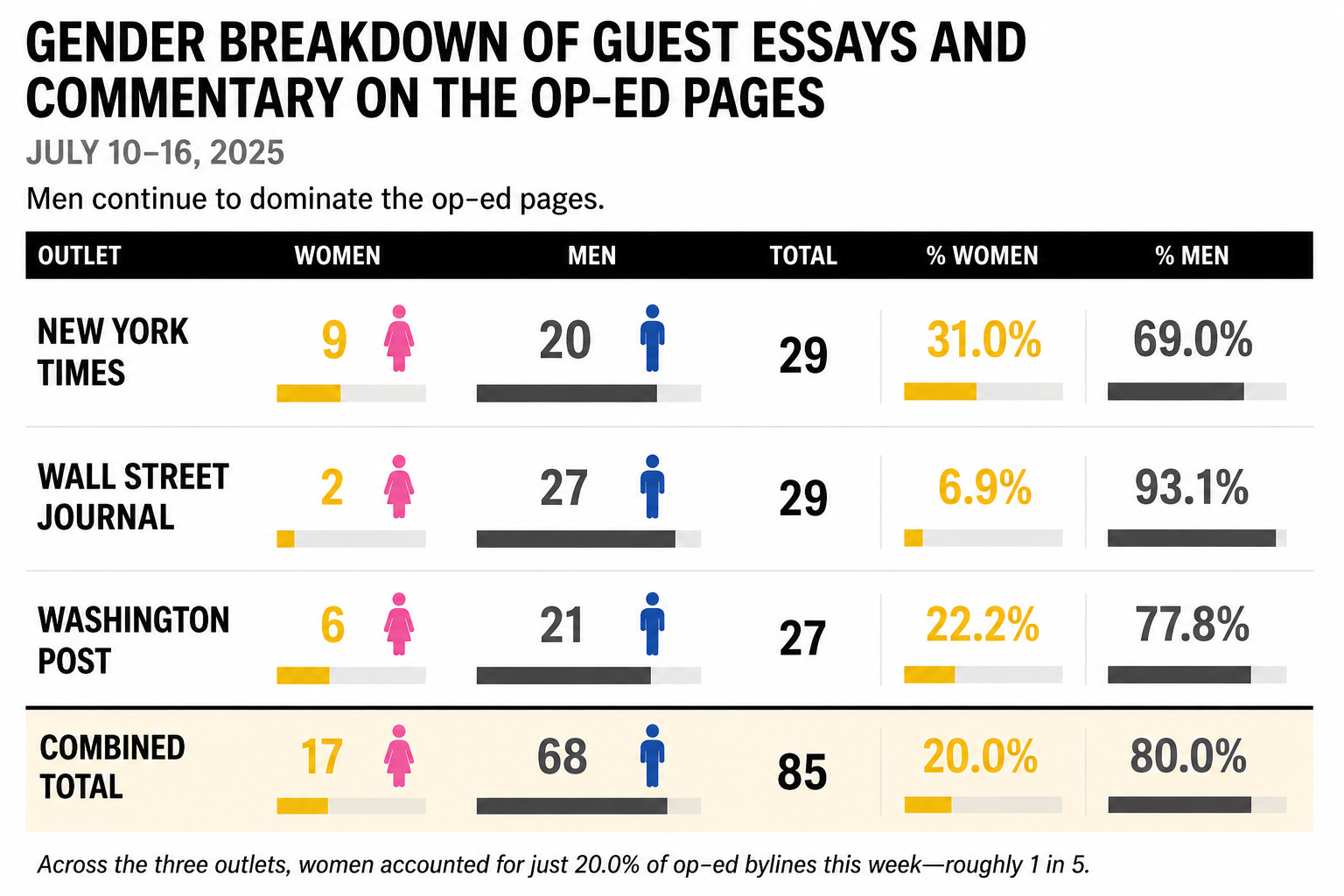
Well, these numbers aren’t great. We’re looking at 1 in 5 op-eds by women. The WSJ does the worst this week, not just because it ran a piece by Marco Rubio blasting the ICC.
📚Interrupt Your Bookshelf 📚

What if news was recounted through the prism of the actions and decisions people take for those they love? Would it become harder to dehumanize those who seem different to us? Sally Hayden has reported from war zones and disasters. Amid the horror, she has witnessed goodness—of people and the power of love. Her new book, This Is Also a Love Story, shows how generosity and sacrifice prevail amid horror.
You can win a copy of the book by entering a drawing. You must be an active Interruptrr subscriber and be in the continental US. Deadline for entries: Monday, July 20 at 9:00am ET.