

Go Big AND Go Home
From the US-Iran standoff to the collapse of local news.

Lots of birthdays this week…Happy birthday Lina, Kate, Tom, Christine, Aleksandra, and Grace! 🎂
Congrats to Meg Peralta-Silva, winner of the book giveaway. She’ll get a copy of Katie Benner and Erica Green’s Miracle Children. Bonus: Katie and Erica said they’d sign it! 🥳
I’ve changed up the order this week, putting my column after the week’s news. Not sure that will be permanent, so consider it an experiment for now. On that note, expect a survey in your inboxes soon. 💌
My beautiful 11 year-old niece is a budding foreign policy expert. Her class has put together a website on the UN Sustainable Goals. It includes ways on how we can achieve them. If you can, please fill out the feedback form—to encourage her and her classmates to continue to fight for the world! #ProudAuntie
Happy Olympics…and Go Seahawks!
This Week in the World.....

On our radar...
The US-Iran Standoff
US and Iranian officials meet in Muscat, not Istanbul, on Friday, February 6. The Iranians insisted on the changed venue to Oman, which it sees as a more controlled environment without the shadow of “regional” powers, which Turkey is.
While the US and Iran have agreed to talk, let’s not forget, however, that Trump has, what he described, a “beautiful armada” in the Gulf now. In January, he dispatched ships, F-15 fighter jets, and air defense systems. We saw what happened in Venezuela after Team Trump built up its presence in the Caribbean. Yet, the powers in the Middle East—Turkey, Qatar, Saudi Arabia, UAE, and Egypt have appealed to the White House NOT to strike Iran, warning that a confrontation will likely lead to a regional war. Look at that, the Middle East unified on something.
Interestingly, Trump talked to China’s leader, Xi Jinping, on Wednesday. In the call the two discussed Iran, which China depends on for oil. So, in theory, he’s not interested in destabilizing Iran, but, more importantly, he doesn’t want to upset oil prices and shipping routes. The WSJ reports that Xi told Trump that the “‘US has its concerns, and China has its concerns,’ and said a solution could be found if both sides approached each other with ‘reciprocity.’” In other words, you do you and when I do me, particularly in Taiwan, I want you to keep minding your own business—orange one.
Where is this headed?
The Economist believes it is headed to confrontation 😳, noting that the “prevailing view in Washington is that..talks will fail. The question is not whether Mr Trump will strike Iran, but what he will strike and when.”
This week, the US shot down an Iranian drone that was directed at US ships in the Gulf.
In the event that diplomacy fails, the US is likely to strike Iran. The question is to what extent?
There is a scenario that the US does in Iran what it did in Venezuela—that is to remove Khamenei. That would require more than just air strikes and would not be as easy as capturing Maduro—unless Israel has the intelligence resources required to turn those close to the Islamic cleric to turn on him.
The other scenario is that the US does what it did in June—strategic strikes. This time it would extend beyond nuclear facilities to include military command structures. That would further weaken Iran, but not eliminate the Islamic regime.
How will Tehran react?
Tehran has said that it will retaliate in the event of a US strike—much more seriously than it did in June. This, many fear, will lead to a regional war. In that scenario, things might get ugly for Trump, writes Ellie Geranmayeh. (ECFR)
The one question that has been thrown around, but I haven’t seen the Trump administration addressing is: If Iran’s mullahs are toppled, what happens next? As we saw in Iraq and Afghanistan, democracy does not follow. Iran’s opposition is non-existent. Does the Islamic Revolutionary Guard Corps, Iran’s military, takeover? With its hands full in Venezuela and, frankly, Minneapolis and ICE, it is hard to see how Team Trump justifies taking over in Tehran. While Iranians don’t like the mullahs, they don’t like the US government either. Holly Dagres is smart on all things Iran. Read her Substack, The Iranist, to stay up to date.
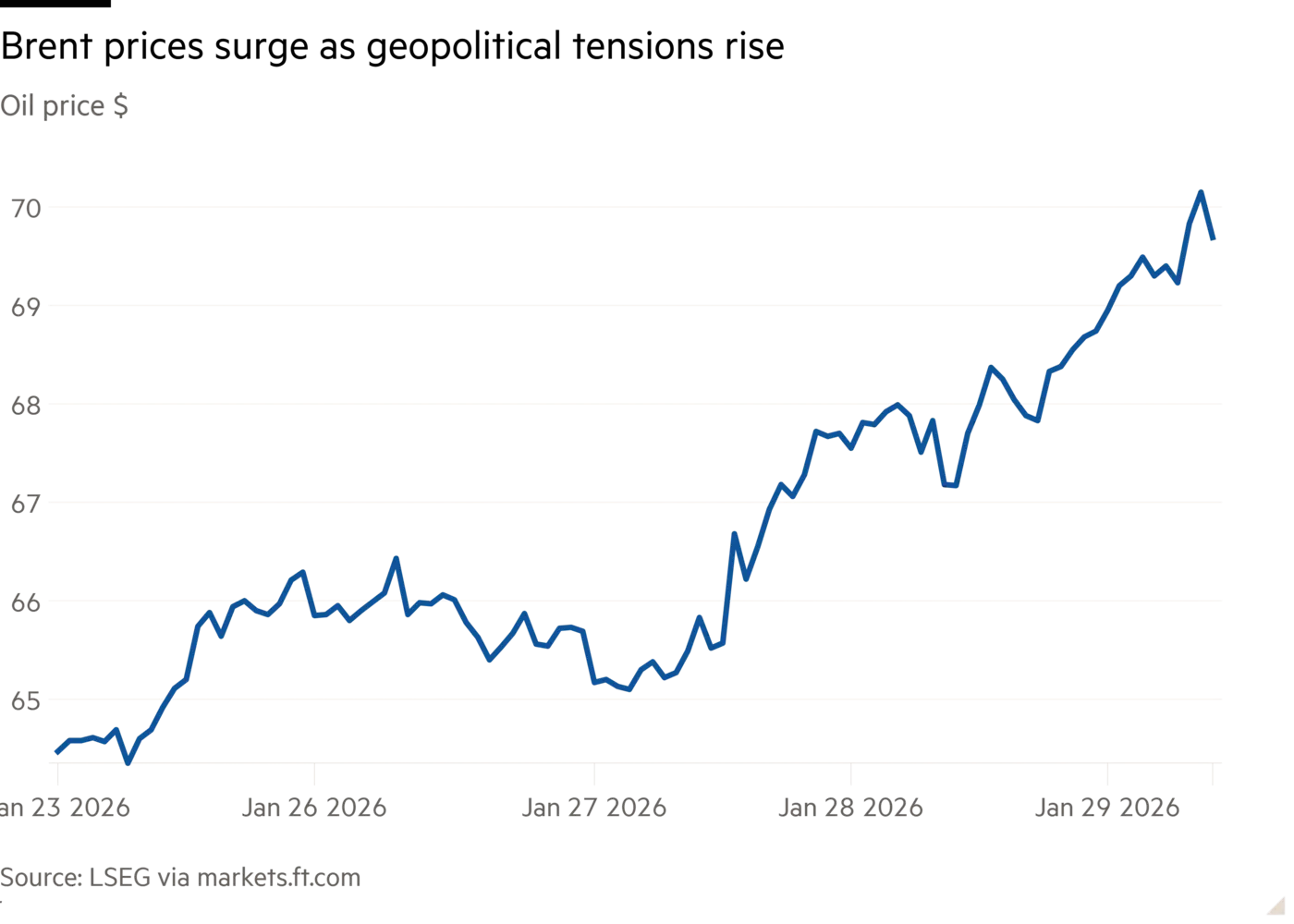
One thing is likely: Oil prices will probably rise—because they are.
Start stops
On February 5, the last US-Russia arms control treaty, New Start, expired. Start stands for Strategic Arms Reduction Treaty, which is exactly what it did. Georgia Cole notes that without the treaty, a new arms race is likely, especially because China is expanding and modernizing its nuclear capabilities. Worse, it increases uncertainty. (Chatham House)
Japan elections
Japan heads to the polls this Sunday. The country’s newish prime minister, Sanae Takaichi, who’s been in power for only a few months, called snap elections, she says, in order to get the public’s backing for her leadership. Given her high poll ratings, it just might pay off. Erica Yokoyama and Akemi Terukina on how Takaichi has won over young voters. Spoiler: It involves K-Pop demon hunters. (Japan Times)
What do Japanese voters care about? Affordability, stupid! But there are a number of other factors at work. Sheila Smith notes that one of them is foreigners, both as tourists and residents. She points out the rise of a far right party, Sansietō, which call for a “Japan first” approach. The party won 14 seats in last year’s parliamentary elections. It may be one of the reasons that Takaichi has been more hardline on immigration issues. (CFR)
After USAID
It’s been one year since USAID shuddered its doors. A new study in the Lancet Journal says that global aid cuts “could lead to at least 9.4 million additional deaths by 2030, if the current funding trend continues. About 2.5 of those deaths are projected to be children under the age of 5.” Lauren Kent reports. (CNN)
Africa
Is there a genocide against Christians happening in Nigeria? Trump says so. In December, he launched missile attacks in the country’s north, targeting Islamic extremist groups. Dionne Searcey, Ruth Maclean, and others write that Christians and Muslims are targeted equally in the country and point out that Christian lobbyists have captured Trump’s ear on what appears to be false claims. (NYT)
Asia
Last week I mentioned that the EU and India signed “the mother” of all trade deals—and we were all waiting for Trump’s reaction. Rather than throwing a temper tantrum, he lowered the 50 percent tariffs that he slapped on the country—for buying Russian oil—to 18 percent. What does this hold for US-India relations and the rest of the world? Elizabeth Threlkeld, Akriti Vasudeva Kalyankar, and Daniel Markey discuss. (Stimson Center)
Following on from General Zhang’s detention on supposed corruption charges, Mary Gallagher thinks that the chances for a Chinese grab of Taiwan—and, thereby, an ensuing war has increased. (WPR)
Thailand heads to the polls this weekend. But will they matter? For decades, the country’s monarchy and military have curtailed the people’s will. While it looks like the People’s Party is favored, odds are that incumbent prime minister, Anutin Charnvirakul will prevail, writes A. Anantha Lakshimi. (FT)
The UN Assistance Mission in Afghanistan (UNAMA) is up for renewal in March. Annie Pforzheimer advises that the UN Security Council strengthen UNAMA’s unique political role, particularly the “call for a political roadmap that derives from negotiations between the Taliban and other Afghan stakeholders.” (IPI Global Observatory)
Latin America
In Costa Rica, right wing populist Laura Fernández won the presidential election, as predicted. She’ll follow on from outgoing leader, Rodrigo Chaves. She’s seen as a loyalist to Chaves who said she admires Nayib Bukele’s rule in El Salvador, so expect security issues to dominate her tenure. Though Costa Rica is a small country of about 5.3 million, “her victory consolidates a populist mandate that prioritizes security and executive power at a moment of escalating drug violence,” writes Sana Khan, who notes that the prospect for constitutional reform and curtailed civil liberties is real. (Modern Diplomacy)
Won’t you be my neighbor? Trump met with Colombia’s president, Gustavo Petro this week. And much to everyone’s relief, it went smoothly… Just a month ago, Trump called Petro a “lunatic” with “mental problems”…. Yet, with Maduro’s decapitation in Venezuela, Trump needs Colombia to keep things in Venezuela in check. So, antagonizing the country and threatening to invade it are not helpful.
Middle East
While the world has its eyes locked on Iran, Saudi Arabia is making moves. This week, Turkish President Recep Tayyip Erdoğan traveled to Riyadh. And to think it was only in 2018 when Saudi officials killed Jamal Khashoggi at the consulate in Istanbul and Erdoğan harangued the kingdom. But with changing dynamics in the Middle East, namely Iran’s weakening and Assad’s demise in Syria, both Turkey and Saudi Arabia are shifting course. Frida Ghittis zooms in on Saudi Arabia, which she writes is moving away from the US and Israel. (Insight)
Why are so many women falling to their deaths in Turkey? Ruth Michaelson and Beril Eski look at increasing femicides in the country. (The Guardian)
In Libya, former dictator Muammar Qaddafi’s son, Saif, was killed.
Europe
In France, the parliament managed to pass a budget, without a prime minister resigning. Sophia Khatsenkova reports. (EuroNews) Whew.
Under the Radar
The UN Secretary-General said that the multilateral body faces “imminent financial collapse” unless members pay up. Cough, cough—that’s you, United States. The US owes $2.196 billion to the UN’s regular budget, and $1.8 billion for peacekeeping operations. More importantly, however, is the need to overhaul the financial rules, as Damilola Banjo points out. For one, the UN has to return unspent funds to a member state—even if that state hasn’t paid its dues. The UN returning money it never received. (PassBlue)
Postscript

Last spring, my friend Caroline traveled to Japan, where she took a class to make wax replicas of food. It’s an art devoted to patience and precision. It brought to mind something another friend, Tom, once told me about Japan: the Japanese fascination with the intricate. In Japan, the best restaurants seat no more than ten people. The goal is not just intimacy but depth. It’s no wonder that Japanese whiskey rivals anything from Scotland or Kentucky. The best pizza: it’s in Japan. Rather than “go big or go home,” Japan’s default is to specialize, even if it only reaches a few people. In fact, it’s better if it only stays local.
That’s the opposite of what has been happening in the West. For so long we’ve been obsessed with supersizing—portion sizes and shopping—and getting the best deal. I’ve previously written about how big box retailers such as Zara and H&M have replaced mom and pop shops. Costco has replaced the local grocer, where we had a relationship with the proprietor and, at times, could pay later or “work something out.” My friend Christine writes about an Athlete’s Foot on the Upper West Side of Manhattan where, not so long ago, you could once do that. No more. We have traded in trust for the mass market.
The same is true for the media.
It is hard not to mourn the dismissal of 300 journalists at the Washington Post this week. Not only because of the human cost—hundreds of lives upended—but because it speaks to a larger phenomenon we’ve been watching unfold in real time: the ultra-rich callously hollowing out institutions ordinary people still rely on, with little visible regard for the downstream consequences.
What struck me most about the Post layoffs was what was cut. The books section—an irony, given that Jeff Bezos’s fortune was built on books. Sports. International coverage, particularly in the Middle East. Local reporting.
The disappearance of local news is something my friend Bene, a media consultant, has put on my radar. She works local news teams and has witnessed how so many have vanished across the country—eclipsed by national networks, namely CNN and Fox. This erosion leaves people uninformed about town meetings, court decisions, school boards, school fairs, labor disputes and wins, infrastructure projects, pie contests, talent shows, what the city council and mayor are up to, and local success stories. When people can’t see what’s happening in their own community or, simply, the community itself, they’re disconnected and, as a result, lose trust in the institutions meant to serve them—and, worse, lose touch with their community. Local news has long been the neighborhood glue.
As that disappears, people become untethered. In the absence of shared civic spaces, belonging migrates elsewhere—into louder, narrower, more absolutist worlds. Perhaps this is why, even as we are more connected than ever, we talk so much about isolation. A society built entirely for scale may be efficient, but it is not especially good at holding people together. —Elmira
Opportunities
Book club alert! Lourdes Martin is the author of the Please, Do Tell Substack. For her next book club, she’s selected, The Undocumented Americans by Karla Cornejo Villavicencio. Here are the details. I’ll be there. Join me!
Do check out Bene Cipolla’s new website Allium Partners and put her on your radar.
The Fuller Project is dedicated to journalism about and for women. They’re taking pitches. And checkout their redesigned website. Kudos Eliza and team!
World Politics Review is hiring an Assistant Editor. Go work with Elliot. He’s awesome.
Editorial Team
Elmira Bayrasli - Editor-in-Chief