
Happy birthday Dan, Renee, Carrie, and Lyric!
Tomorrow, August 15, marks the 5th anniversary that the Taliban re-took Kabul. I don’t refer to it today, because there’s too much to say. I will have a separate post about this.
Thanks to everyone who subscribes and supports this newsletter. It’s $8 per month or $80 or $150 per year, with different offerings, including writing office hours and access to expert conversations. Also, I link to gift articles you’d otherwise have to pay for!
I’m holding office hours this coming Monday, August 17 at 12pm ET. We’ll look at “what an op-ed is” in my effort to get more women bylined. I’ve got a few editors from op-ed pages lined up to speak soon. —Elmira
This Week in the World.....

On my radar...
Mecca Pact
Last Friday, Pakistan, Saudi Arabia, and Turkey signed a mutual defense pact, called the Mecca Joint Defense Agreement. It’s being framed as a Muslim NATO, though Frida Ghitis says it’s hard to see Saudi Arabia and Turkey go to war over India, as one example. This should be seen more as a political alliance—an alternative to the US—rather than a Sunni military alliance, which is how Tehran sees it. (World Politics Review)
And sure enough, on Thursday, the Turkish defense ministry outlined how the accord would involve “strategic political and military mechanism” coordination. That would include joint military exercises, “in addition to deeper defense industry cooperation.” Read: we’re going to build and sell weapons.
This pact shows that this is a totally different Middle East, one which the US is no longer the leader to follow or turn to.
Colombia earthquake
A 7.4 earthquake struck Colombia this week. The tragedy comes a few days after Abelardo de la Espriella took office as president. The Nayib Bukele-like right wing lawyer who never held elected office now faces an early test of the platform that brought him to power. He campaigned on reversing his leftist predecessor’s “total peace” approach by cracking down on rebel groups and cutting government spending. Now, his government must spend on rescue and relief efforts immediately and then recovery in the longer term.
The challenge is complicated by the crisis that preceded the earthquake. Lara Loaiza Aria points out that Colombia had already been facing its worst humanitarian crisis in years, “with rising violence by armed groups.” Can Espriella’s security-first approach help humanitarian groups reach those most in need—or make their work even harder? (The New Humanitarian)
Last week, the Trump administration pledged $1 billion to Colombia in “security assistance.” And already the US is floating the idea of joint strikes on armed groups. This week, the administration added an additional $15.5 million in response to the earthquake.
Turkey and the Kurds
That bill before Turkey’s parliament calling on former Kurdish fighters to give up their arms and be reintegrated into society passed this week. It protects certain individuals—not all—who fought on behalf of the PKK, a terrorist group, from prosecution or a suspension of sentences. Senior PKK leaders, like PKK founder Abdullah Öcalan, are excluded. So, it’s not a full fledged amnesty and it has, as Ezgi Başaran points out, “comes hedged with conditions.” To start, disarmament must be certified by Turkey’s intelligence service and then by the National Security Council. (Angle, Anchor, and Voice)
Recep Tayyip Erdoğan’s government claims that this law is a step towards peace. Yet, it says nothing about Kurdish rights or the anti-terror laws used against Kurdish politicians such as Selahattin Demirtaş, who has been in jail since 2016. But as the Turkish president’s time in office runs out in 2028 and he looks to extend it through a parliamentary amendment that reverses the two-term limit, he needs the support of Kurdish parliamentarians. Erdoğan’s Justice and Development Party (AKP) has 277 seats and his ultra nationalist coalition partner, MHP, has 46, giving them a total of 323 seats, short of the 400 votes needed for a direct amendment and 360 to put an amendment to voters. While the Kurds might not be so quick to support the Turkish president, they might be less willing to get behind the main opposition, which has traditionally been very anti-Kurdish. In my cynical assessment, Erdoğan pushed this law in order to remind the Kurds that he’s the lesser of the two evils. That’s why the opposition leader Özgür Özel’s “yes” vote, supporting the law’s passage, was, as Başaran alludes, so shrewd.
The Hormuz and Houthis
That deal between Oman and Iran over the Hormuz has not materialized yet. While this continues to dominate the headlines, there’s really nothing new here. What is worth mentioning is the renewed Houthi attacks in the Red Sea and in Yemen.
The Houthis are a Shiite Yemeni-based group aligned with Iran that had been, until a ceasefire in 2022, locked in a civil war in Yemen. After Saudi Arabia attacked the group traveling back from Tehran from Ayatollah Ali Khamenei’s funeral in early July, the Houthis came off the sidelines and started threatening vessels passing through the Red Sea. Fatima Abo Alasrar says that this is a calculated gamble that risks drawing the Houthis into direct conflict with Saudi Arabia—and losing territory and power. (Foreign Policy) 🎁🔗
Bridget Toomey outlines how it’s increasingly looking like Yemen might return to civil war. (Long War Journal)
US
Russia has freed Robert Gilman, a US national and former Marine, who has been imprisoned since 2022. From the looks of Gilman on the flight to the US, he was not in good health, which is probably why Russia released him on “humanitarian grounds.” Take that to be code for “I don’t want an American to die on my watch before the midterm elections in the US, especially since my war on Ukraine isn’t going as I planned.”
Africa
Ebola deaths have surpassed 2,000. Why that is worrying is, as Barry Malone points out is that “it took about nine weeks for the outbreak to reach 1,000 deaths, but it’s taken just three weeks for that figure to double.” As of August 13, there have been 2128 deaths and 4566 infected.
Zambia held elections on Thursday, which is fascinating that there is another country that holds elections during the week and not on a Sunday. The country is one of the world’s largest copper producers and is a source of lithium and cobalt, which are key in smartphone production. That’s only one reason many (China and the US) are watching the results with great interest.
The drama surrounding the election is another. Carien du Plessis lays out a soap opera worthy scenario involving the burial of former president Edgar Lungu, who died in June 2025—LAST YEAR. Lungu had finished his term in 2021 and died while in South Africa. Incumbent President Hakainde Hichilema has called for Lungu to be buried in Zambia. Lungu’s family has said that Lungu didn’t “want his successor ‘anywhere near his body.’” 😲
Lungu supporters say that Hichilema wants access to the body to perform witchcraft—allegations he has vehemently denied. The bizarre dispute is a boost to the opposition, even though Hichilema, who is accused of becoming increasingly authoritarian, is poised to win. (The Africa Report)
Asia
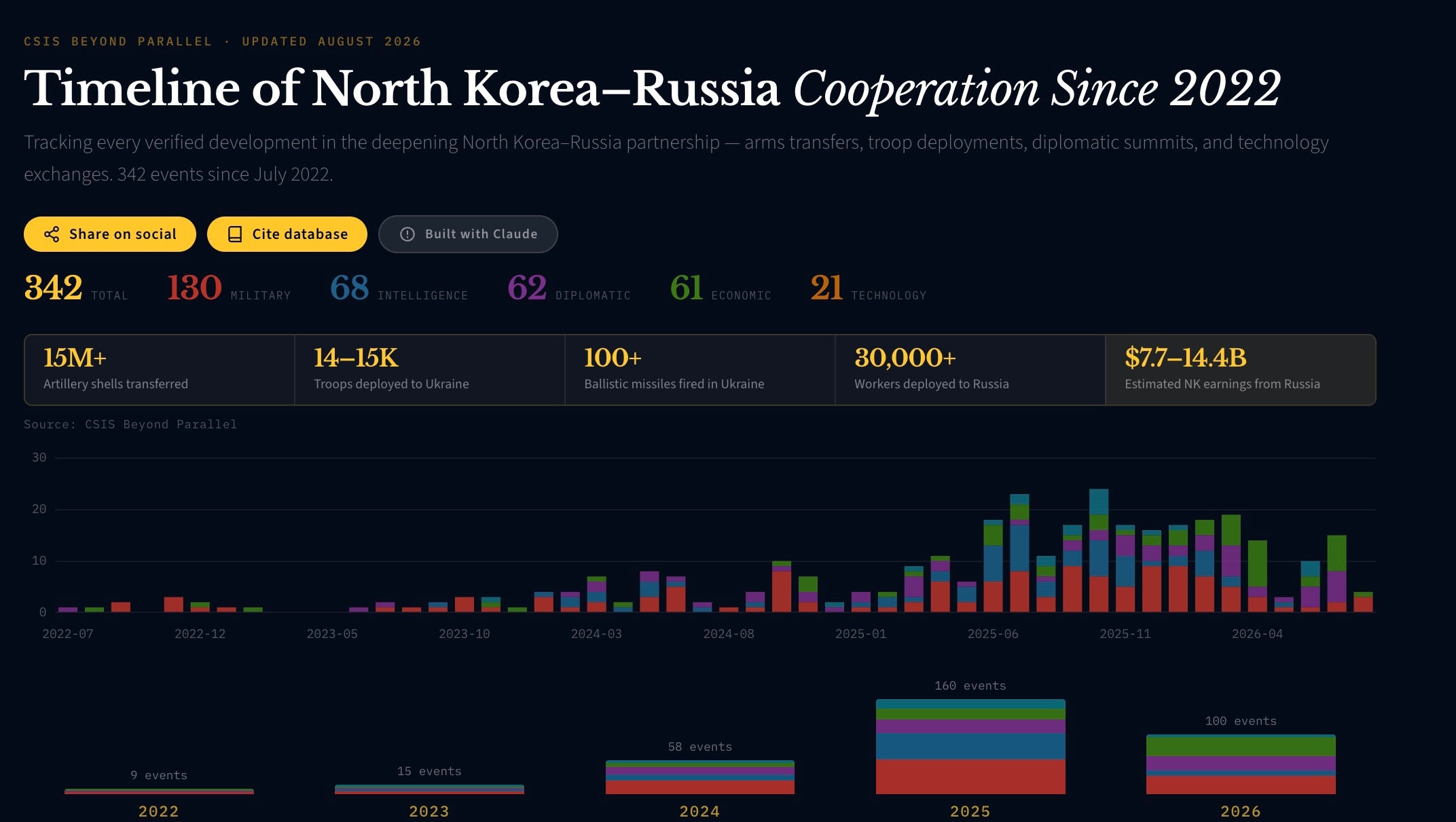
North Korea tested another ballistic missile this week, just as the US and South Korea prepare for annual military exercises. And it is deploying weapons against Ukraine, on behalf of Russia. This week, North Korean missiles struck Ukraine, killing nine. (Kyiv Post)
CSIS has been documenting the Russian-North Korean alliance, where I stumbled on this entry that a Moscow staffing agency has posted that 40 North Korean women are for hire to make kimbab. 🤨 (CSIS)
Here’s something that raised my eyebrows 🤨: Putin traveled to Etorofu Island on Thursday. It is an island that Japan claims but Russia seized during World War II. Japanese Prime Minister Sanai Takaichi was NOT happy. The Institute for the Study of War notes that it is “likely in response to the more assertive defense policy Japan has recently adopted,” referring to a white paper published in early August. (ISW)
What’s more interesting: Reuters has this snippet about a joint Russia-China statement:
Earlier on Thursday, Nozdrev and Chinese ambassador Wu Jianghao issued a joint statement pledging to oppose attempts to revise the results of World War Two. They also warned against re-militarisation in the Asia-Pacific, language that echoes Moscow’s rejection of Japan’s claim to the islands.
So while Ukraine seems to be making gains against Russia, Putin is turning to North Korea—and showing up for China.
Meanwhile, China and Indonesia are teaming up for navy drills. With what’s happening with the Strait of Hormuz, this is something to keep a close eye on. Indonesia, along with Malaysia and Singapore, abuts the Strait of Malacca, where 40 percent of global trade traverses. Paola Morselli notes that this makes it a more critical chokepoint, even if its closure would be harder to implement. But that doesn’t rule out the charging of tolls. (The Diplomat)
Al Jazeera has an interactive feature that looks at the world’s straits and channels.
Former Chinese leader Zhu Rongji, who oversaw China’s economic reforms in the 1990s, died this week at 97. Emily Fang notes how he navigated and survived the Chinese Communist Party during the Mao era, where he criticized the founder of the country. She also talked to Charlene Barshevsky about how Zhu opened up and made China’s economy more “compatible” with the US. (NPR) I’d love to have the time to dig into this some more.
Middle East
Lebanon became the second Arab League country, after Djibouti, to abolish the death penalty.
In Syria this week, a court sentenced Bashar al Assad and his brother Maher, in absentia, to death for murder, torture, and crimes against humanity committed during the country’s 14-year civil war. Both Assads fled to Moscow in December 2024. While this prompted celebration, it also presents a dilemma for a Syria trying to rebuild, writes Deborah Amos. That’s because there are 5,000 others implicated with the Assad regime and atrocities. If they’re also going to face the death penalty, the evidence that the UN has collected cannot be used in any of their trials. So, the question becomes, is justice about punishment or establishing a system that presents and considers evidence and provides due process? (Deb’s Substack)
In the West Bank, Israeli settlers have been terrorizing Palestinians, in an effort to expand territory. Two weeks ago, they burned down two mosques. This week, settlers have circled several homes, cutting off water and electricity, in an effort to force them out. The US Ambassador to Israel, Mike Huckabee, called the settlers actions “an act of terror.” The UN has said that the situation has reached a “breaking point,” which is an understatement. Julia Conley has more. (Common Dreams)
Europe
It’s no secret that elections in Russia are not free or fair. But the fact that they’re still held presented an opportunity for the political party Yabloko to become a vehicle for anti-war and opposition voters to mobilize. Ksenia Smolyakova notes that after Yabloko got onto the ballot for next month’s parliamentary elections, its online engagement grew 4.5 fold. This week, Russia’s supreme court ruled that the party had engaged in “extremism” and pulled the party from the ballot. But while this may have quashed Yabloko, it doesn’t eliminate “opposition sentiment” in Russia. (Riddle)
Hungary has a new president. Former head of the Hungarian Supreme Court András Baka took office this week. In a speech this past Tuesday, he said that polarization was inflicted upon Hungary, without referring to Viktor Orbán by name. And that a society divided cannot have a shared future. (Budapest Times)
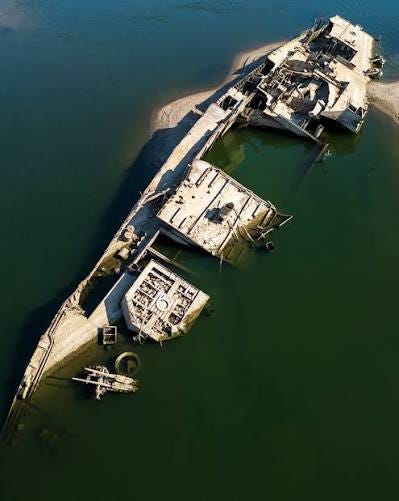
Yes, the eclipse was one of the big stories out of Europe this week. But this one about the Danube, Europe’s second longest river after the Volga drying up and literally unearthing sunken Nazi ships is stunning.
Would love to know what you think, or what I got wrong or left out— here’s my email.
Opportunities
The Atlantic Council is hiring for a VP and Senior Director of the Scowcroft Center for Strategy and Security.
The Bulletin of the Atomic Scientists is taking applications for its Editorial Fellowship.
In DC, One is hiring for a Policy Officer.
Gender Tracker
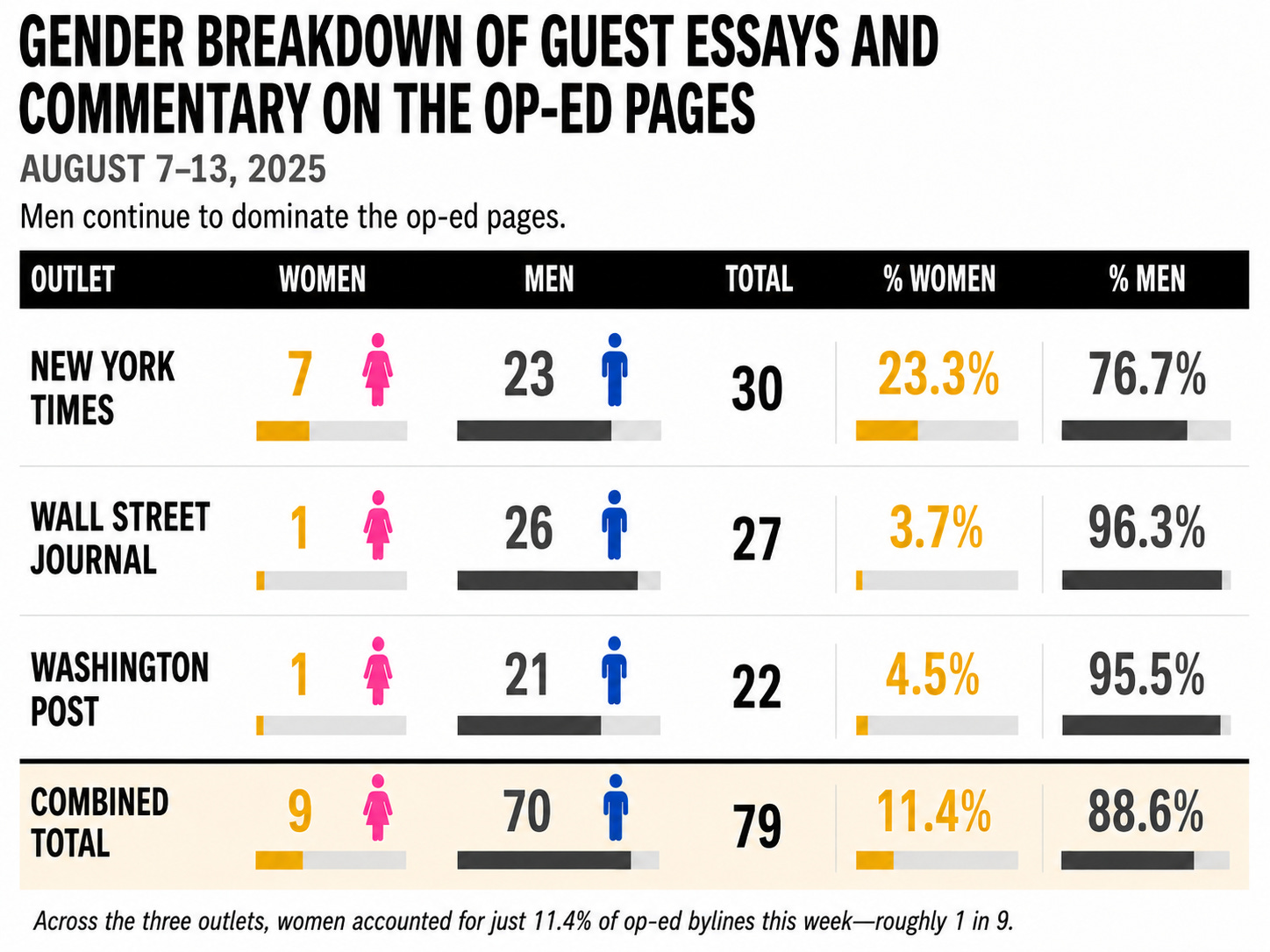
We have regressed this week, with only 7 women bylines at the NYT and one a piece at the WSJ and WP, which ran a post from a regular contributor. Sigh. So, we’ve only got 9 women bylined this week in the major US papers—11 percent.