The Week, Interrupted: July 10
Iran's leverage, NATO's new reality, Sudan's complicated war, Le Pen's ambitions and the Gender Tracker!

Happy birthday Şenaycım.
As noted last week, I’ve moved the column to Tuesdays. Fridays are just the roundup. Hence, the headline change. Lemme know what you think!
The big news headline in the US this week was Graham Platner. He had been the Democratic candidate for Senate in Maine—the northeastern most US state of about 1.4 million. A revelation that he raped a former girlfriend forced him to step aside. Yet, this is not just a domestic political story. It is global—about power and how men wield and abuse it and the systems and institutions that are blind to it.
Rebecca Traister, who is one of my idols—a feminist and writer extraordinaire and, incidentally, a Maine resident, has this reflection about Platner’s appeal to women, who formed the majority of his base. She writes, “(i)n our political system, women are too often forced to depend on men. And those men often catastrophically fail us.” That is far truer outside the US. I hope to publish a guest post on this next week. —Elmira
This Week in the World.....

On my radar...
Iran
In Ankara, at the NATO Summit, Donald Trump said that the US-Iran ceasefire is “over,” calling the Iranians “scum.” This does not mean that the peace talks are over, however. As of Friday morning, July 10, they’re still scheduled for Sunday.
The latest flareup comes after Iran struck three tankers in the Strait of Hormuz. The US, eager to strip Tehran from having that leverage, lobbed missiles and drones at Iranian targets. Nancy Youssef, Vivian Salama, and Jonathan Lemire note that while Iran is not interested in renewing conflict, it’s also loath to give up the power the strait has given them over the past few months, power which the MOU, signed three weeks ago, aims to curb. (The Atlantic) 🎁🔗
And from the display put on at Ali Khamenei’s delayed funeral this past week, Iran is clearly feeling mighty. Fateme Karimkhan notes that the week-long event made a point to display power. Red flags fluttered throughout the country. In Shiite symbolism they signify vengeance and the funeral’s timing during Muharram, the first month of the Islamic calendar, was used to place Khamenei’s death inside the martyrdom narrative. (New Lines)
At the same time, however, the funeral also posed questions about who is in charge of the country. Major political figures, namely Khamenei’s son Mojtaba, who was anointed his successor, were absent. That has prompted questions about where he is and who’s really in charge. Good question….There are theories that he may be dead. Seems to me if that were true, it would be hard to keep a secret—and something that Israel’s intelligence services would have picked up on.
On those absences, Kayhan Life says they reveal a regime in crisis. Yes, it was a massive display, but look closer and there were no senior members of the Shiite clergy for a man who had been presented as the “leader of Muslims.” Nor were there any regional heads of state for a country that claims to be a regional power. (Kayhan Life)
Will the US and Iran go back to war? Unlikely, says Frida Ghitis—for the same reason Trump signed the MOU: the US midterm elections. (Insight)
OPEC said it will raise oil production in August: More oil, lower gas prices.
NATO Summit
Here is the final NATO Summit declaration. It tracks with my NATO analysis from Tuesday. It reiterates the alliance’s commitment to Article 5, “an attack on one is an attack on all.” It reiterates the “unwavering” support for Ukraine’s defense and pledges “€70 billion in military equipment, assistance and training.” And commits to working towards “eliminating defense barriers,” that is equalizing defense spending, which has been Trump’s consistent complaint.
Juliette Bretan has a piece that pushes back on that grumbling, noting that Eastern Europe—Poland, Latvia, Lithuania, and Estonia have not only upped defense spending, they’re actually building weapons and holding exercises. (Newsweek)
Other takeaways:
On the summit’s first day, Trump reasserted his claim that Greenland belonged in the US orbit and quipped that Spain is a “terrible partner,” calling to cut off trade with the country. Spain had refused a US request to use Spanish air bases for its war on Iran. Spain has also refused to up its defense spending in NATO. Because Spain is in the EU, the US can’t technically cut off trade with it as an individual country. Spain is the US’s 23rd trading partner, exporting more than it imports, with $26.6 billion going to the country. This piece explains how Trump could possibly get around that, which just seems like more effort than it’s worth. (US World News & Report)
By the end, however, Trump proclaimed that he was “feeling the love.” We didn’t know you had that capacity Donald.
Turkey’s president, Recep Tayyip Erdoğan, was definitely feeling Trump’s love. Trump announced that he would lift sanctions that were preventing Turkey from participating in the F-35 fighter jet program. Trump leveled those sanctions in his first term, in 2019, after Turkey purchased Russian made S-400 air defense systems. Not sure how far that gesture will go since Congress is the authority to lift the sanctions and when it comes to Turkey there is definitely bipartisan disdain for the country and Erdoğan, in particular.
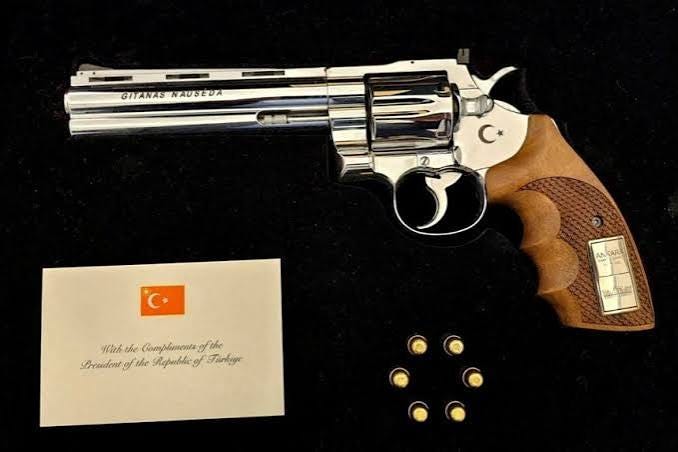
For his part, Erdogan gave each head of state a gun as a gift. No, you can’t make this stuff up.
And on weapons, as I noted in my Tuesday deep dive on the NATO Summit, Ukrainian President Volodymyr Zelensky could put on in the win column if he secured arms commitments from Trump. He did—sort of. Trump said the US would give Ukraine a license to manufacture Patriot missile interceptors. I’m sure that was news to RTX, the company that makes those missiles. And while that sounds “supportive,” it will take some time before production gets underway (and where that will happen is unclear), leaving Ukraine vulnerable in the meantime.
Kelley Beaucar Vlahos also believes that this creates a vulnerability to US defense, making it much easier for competitors to get sensitive information about US military systems. (Responsible Statecraft)
Given rising temperatures across the continent, Europe would be wise to get serious about tackling climate change, which is becoming an increasingly important national security issue, writes Erin Sikorsky. (Foreign Policy) 🎁🔗
US
One of the three bilats that Trump held was with Syrian President Ahmed Al-Sharaa. Trump took a liking to Sharaa when he came to visit the White House last year. Then he lifted sanctions on the country. Yet, as Eleanor Mueller explains, that did nothing to get investments and trade into Syria going—because the country remained on the State Department’s terrorism list. Trump said he would lift that designation, which has been in place since 1979. (Semafor)
Africa
The CDC reports 602 deaths and about 1700 confirmed cases across Congo, Uganda, and France, as of July 9.
In Sudan, things in El Obeid are on the brink of catastrophe, as UN Human Rights Chief Volker Türk noted on July 3. Sudan’s military and the Rapid Support Forces (RSF) militia group have been locked in a civil war since April 2023. Earlier this year the RSF carried out what the UN this week called genocide in El Fashir, in the Darfur region in the west. There is high risk of the same crimes in El Obeid, which is a major logistics route that links the capital, Khartoum, to Darfur. The Africa Center dives into complicated layers of this conflict, explaining that the numerous militias fighting on behalf of the two sides make reaching any settlement difficult. It is not one civil war, but many mini turf battles. (Africa Center)
As the UN discussed this matter, Western governments hesitated to call out the United Arab Emirates (UAE), who have been supporting the RSF, writes Michelle Langrad. (Geneva Solutions)
Listen: Niger, Mali, and Burkina Faso, each led by a military junta, announced they will withdraw from the International Criminal Court (ICC). All three had previously quit the Economic Community of West African States (ECOWAS). Lucy Riley looks at whether this is an assertion of independence or a play to circumvent accountability. (DW Africa Link)
Asia
While the US and European countries met in Ankara, China tested out ballistic missiles—from a nuclear powered submarine. Coincidence? Huizhong Wu lays out the growing militarization in Asia, where China spent $210 billion last year. (AP)
Americas
Things in Colombia are no bueno. Abelardo de la Espriella and sitting president Gustavo Petro have clashed, after Petro refused to acknowledge Abelardo’s win. Abelardo has suspended his transition. He is set to take office on August 7. This is not only a test of Colombia’s institutions, but a worrying sign for what’s to come, writes Angie Acosta. (Latin America Reports)
Over at the UN, the General Assembly voted in favor of a debate brought forward by Havana to discuss the US embargo on the island—despite US efforts to block it, writes Damilola Banjo. (Pass Blue)
A Castro grandson has no interest in politics, but if push comes to shove, he will cut a deal with Trump to preserve the revolution. Romina Ruiz-Goiriena, Kim Hjelmgaard, Francesca Chambers, and others talked to the revolutionary heir. (USA Today)
Middle East
In Gaza, Hamas has relinquished power over to the UN–mandated National Committee for the Administration of Gaza, as stipulated in the US ceasefire brokered in October 2025. But until the group disarms it’s unlikely to move the peace process along, writes Kersten Knipp. (DW)
Europe
In the UK, the government’s “standards” office opened an investigation into Nigel Farage, for receiving a $6.67 million gift from a crypto billionaire. So, Farage, who is the head of the right wing Reform UK party, who pushed for Brexit, resigned. He’ll stand in a by-election, which Rachel Sylvester explains won’t make the corruption allegations go away. (The Observer)
In France, far right leader Marine Le Pen will stand as a candidate for next year’s presidential elections. An appeals court shortened her ban on seeking public office earlier this week. She was convicted of fraud last year. This has certainly upended Jordan Bardella’s plans. He has been Le Pen’s deputy in the National Rally party. Célia Belin and Jeremy Cliffe look at her chances, which seem good and warn that Europe needs to prepare for the possibility of a Madame President. (ECFR)
In Russia, Vladimir Putin is having a harder time controlling the narrative on his war on Ukraine. With increasing fuel shortages and a worsening economic situation, more and more Russians want the war to end, write Maria Snegovaya and Jade McGlynn. (CSIS)
Under the Radar
The International Olympic Committee lifted its ban on Russian athletes competing in the 2028 summer competition in Los Angeles. 🖕🏼
Donald Trump and Italy’s prime minister, Giorgia Meloni, fell out a few months ago, when Trump targeted the Pope. She defended the pontiff. Trump attacked. Nayyera Haq says that’s part of a sexist pattern. (MS Now)
Doug Wilson is the conservative Idaho pastor who wants to abolish the 19th amendment and turn America into a Christian theocracy. Leila Fadel, who proudly notes that she’s a single Muslim woman, sat down with him. This interview is a masterclass on how to handle a misogynistic bigot. Please watch it. (NPR)
Would love to know what you think, or what I got wrong or left out— here’s my email.
Opportunities
In DC, CFR’s Women and Foreign Policy Program is hiring for a Program Associate.
Remote, but Bay Area preferred, Forward Global is hiring for a Chief Partnerships Officer.
In DC, Lawfare is hiring for an Associate Editor.
Re-upping this fellowship opportunity: Applications for the Harvard Radcliffe Institute Fellowship Program close in September. If you’ve got a proposal for a project that addresses a “pressing social, scientific, and policy issues and seeks to engage audiences beyond academia,” this is for you.
Gender Tracker
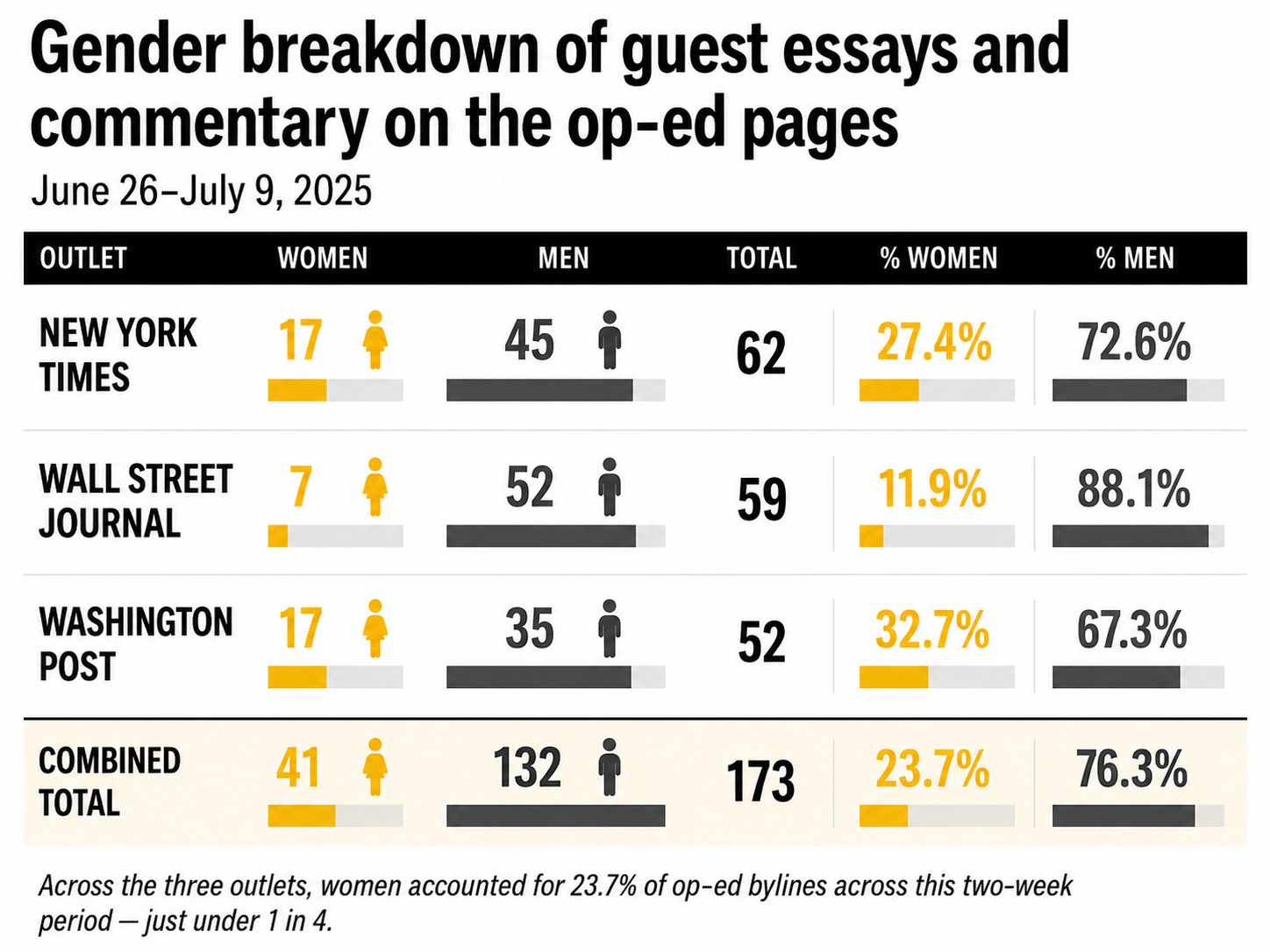
Looking at the numbers from June 26-July 9, the Washington Post, which has trailed for the past few months, comes out on top this week. It ran one piece on the buzzy book Yesteryear, which was just 😲. The numbers for the NYT remain consistent, though I did want to point out there were three pieces by Kate Shaw, one of several regular contributors.